

For a while now, the conversation around AI data centers has been dominated by one question:
Where will the power come from?
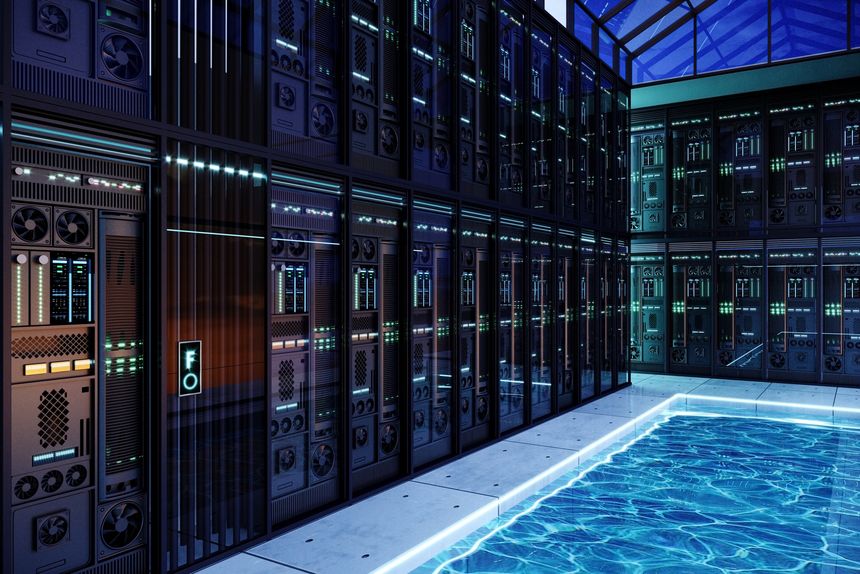
That’s still the right question. But it’s no longer the only one. A new 36MW AI-ready facility near Phoenix is described as being designed not only for high-density compute, but also to operate with zero water use for cooling in a drought-stressed region.
From Power Constraint to Resource Constraint
AI infrastructure is often framed as an electricity challenge, and for obvious reasons. Higher rack densities, bigger clusters, and faster deployment all push power demand upward. But in practice, these facilities are constrained by more than just megawatts. They are also constrained by water, land, permitting, and local environmental limits. The Phoenix facility makes that visible by pairing high-density performance (up to 400kW per rack) with a design that reportedly saves more than 138 million gallons of water annually.
That’s a useful reminder: scaling AI isn’t just about feeding the compute. It’s about understanding the full resource footprint around it.
Why This Is More Than an Efficiency Story
What makes this interesting isn’t simply that the facility is efficient, with a reported Power Use Effective (or PUE) of 1.15. It’s that efficiency is being solved in a way that responds directly to local context.
Too often, digital infrastructure gets discussed as if one template can be deployed everywhere. But AI data centers are becoming too large, too dense, and too resource-intensive for that kind of thinking. What works in one region may be completely misaligned in another.
The Shift That Matters
The real signal here is not just “bigger, faster, denser.” It’s that future-ready AI infrastructure will need to be designed around regional sustainability constraints as much as technical performance.
In other words, the question is no longer just:
Can we build enough AI capacity?
It’s also:
Can we build it in a way that fits the environment it depends on?
BBEB Takeaway
The next generation of AI data centers won’t be defined only by compute density or power availability. They’ll be defined by how intelligently they manage the full set of local constraints around them.
Because in the race to scale AI, the most important infrastructure question may not be how much power you can access.
It may be how little of everything else you can afford to consume.
/Passle/60211dc9e5416a0c14bc63d4/SearchServiceImages/2026-09-15-17-58-27-875-6aa987430810fd5205abc3e8.jpg)
/Passle/60211dc9e5416a0c14bc63d4/SearchServiceImages/2026-09-14-11-49-29-568-6aa7df49942e1ead4d7a1eb4.jpg)
/Passle/60211dc9e5416a0c14bc63d4/SearchServiceImages/2026-09-08-15-36-47-617-6aa02b8fd27ce9f0cbae682e.jpg)
/Passle/60211dc9e5416a0c14bc63d4/SearchServiceImages/2026-09-10-08-39-43-693-6aa26ccfff5bd9fb0fee8b1c.jpg)