
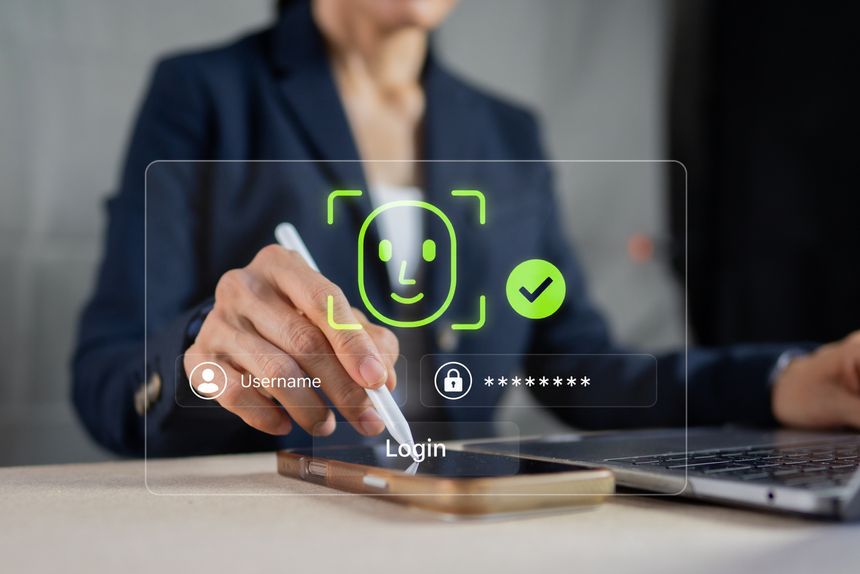

Age checks are becoming a familiar part of the online experience. A website asks for a selfie. An app asks you to move your face within a circle. Another service wants a photograph of your ID and a live image to prove you are the person in the document.
For many people, that is a short interruption before they carry on. For others, it is the point at which the service quietly stops working. If you are blind or have low vision, have limited dexterity or tremor, have a facial difference, or simply do not match the assumptions built into the technology, a supposedly simple check can become a barrier to a service you are entitled to use.
I have been thinking about this after reading Sheri Byrne-Haber’s article, The Faces Age Verification Cannot Read. Her central concern is important: systems intended to determine whether someone is old enough can create predictable barriers for people with disabilities. The question that keeps coming back to me is simple: what exactly are we asking a face to prove?
A useful shortcut can still be the wrong answer
Facial age estimation is often presented as an elegant solution. It can be quick, may feel less intrusive than requiring every customer to upload identity documents, and gives organisations a way to meet their responsibilities to keep children away from age-restricted content. Those are legitimate aims. Children deserve appropriate protection online, and organisations cannot simply look away from the issue.
But facial age estimation does not establish a date of birth. It analyses features of a face and makes a prediction about whether someone is likely to be above or below a chosen age threshold. That distinction is not a technical detail to be hidden in supplier documentation. It is the whole point.
A person’s appearance is influenced by much more than their age. Lighting, image quality, camera position, facial expression and the capability of the device all play a part. So do characteristics that have absolutely nothing to do with whether someone is old enough to access a service.
A face is not an age.
The model is only one part of the experience
It is easy to focus on the model’s accuracy percentage. It is much harder, and much more important, to consider the whole journey when that model cannot make a confident decision.
Imagine somebody who cannot tell whether their face is centred in the frame because the instruction is visual. Or somebody whose hand tremor makes it difficult to hold a phone steady for the required liveness check. Or a person whose facial difference means the technology reacts inconsistently. In each case, the issue is not a failure to engage with the service. It is a service that has been designed around a narrow idea of what a user looks like and what they can do.
Most providers will say there is a fallback. Upload an ID. Try again later. Contact support. Ask for manual review.
That is where the real accessibility question begins. Can the alternative route be completed independently with a screen reader? Are the instructions understandable without visual cues? Can someone take and submit the required images without fine motor control? Does manual review mean revealing information about a disability to a stranger? And will that person wait longer, surrender more personal information, or need help from somebody else to complete what should have been a private transaction?
The fallback is not an edge case. For the people who need it, it is the product.
A number is not an outcome
I made a related point in my recent BBEB post, 71% Accessible Is Still Inaccessible If You Cannot Buy Your Groceries. When I use a website with a screen reader, I do not experience it as a collection of individual criteria or a number on a spreadsheet. I experience it as a journey, with a purpose at the end of it.
That is equally true here.
An impressive model accuracy figure does not tell us whether people can complete an age check independently. A dashboard showing that most users succeeded does not tell us who was unable to get through. A technical accessibility report can identify useful issues, but it cannot prove that the real-world experience works for people with disabilities.
These measures are all proxies. They can be helpful, but they are not the outcome. The outcome is whether a person can do what they came to do, independently, privately and with dignity.
This is why a conformant button can still sit inside an unusable journey. It is why a high automated pass rate can still conceal a very poor experience for particular groups of people. And it is why product teams should be wary when a vendor describes its solution as seamless.
Seamless for whom?
Privacy cannot become the price of access
When an automated age check works for one customer and fails for another, the failed customer may be pushed into a more intrusive route. They may have to upload government ID, provide another image, speak to a support agent, or wait for a manual decision. That is not just inconvenient. It can create an unequal privacy burden for the people the initial process did not accommodate.
The Information Commissioner’s Office has been clear that age assurance needs to be accurate, transparent and fair. Its guidance also says organisations should collect only the minimum data needed, explain how people can challenge an inaccurate assessment, avoid repurposing age-assurance data, and ensure their approach does not discriminate against users.
“None have yet introduced new, viable and privacy friendly age assurance solutions.”
This is not an argument against age assurance. It is an argument against assuming that safety, privacy and accessibility will automatically arrive together because a system uses modern technology. They need to be designed, tested and governed deliberately.
What good looks like
Organisations deploying age assurance do not have to choose between protecting children and including people with disabilities. They do need to reject the false comfort of a single route that happens to work for most people most of the time.
- Provide a genuinely equivalent route that does not depend on facial analysis. It should be usable independently and should not be slower, more difficult or more privacy-invasive by default. A fallback that recreates the same barrier is not a meaningful choice.
- Test the entire journey, including the points of failure. Test the selfie stage, the prompts, retry messages, document upload, manual review and support hand-off with people who have a range of access needs. The primary journey is only half the work.
- Measure who is being failed. Track repeated attempts, abandonment, successful challenges and time to resolution. If people are repeatedly being routed to a more demanding process, that is not an unfortunate exception. It is evidence that the design needs attention.
Ofcom’s guidance describes highly effective age assurance as technically accurate, robust, reliable and fair. Fairness belongs in that list for a reason.
The takeaway
Age assurance is likely to become a more visible part of digital life. That makes it even more important to be honest about what technology can and cannot do.
A face can contribute to an age-assurance decision. It cannot become a substitute for thoughtful design. The responsible organisations will look beyond the automated pass rate and ask the question that matters: when the technology gets it wrong, can every person still get through?
Sources
- Sheri Byrne-Haber, The Faces Age Verification Cannot Read
- Tim Dixon, 71% Accessible Is Still Inaccessible If You Cannot Buy Your Groceries
- Information Commissioner’s Office, Age assurance: estimating or verifying the age of service users
- Information Commissioner’s Office, ICO statement on age assurance
- Ofcom, Quick guide to implementing highly effective age assurance
/Passle/60211dc9e5416a0c14bc63d4/SearchServiceImages/2026-09-21-14-44-06-794-6ab142b68d381308c46013e3.jpg)
/Passle/60211dc9e5416a0c14bc63d4/SearchServiceImages/2026-09-22-20-55-53-229-6ab2eb59e77aebe36a19438f.jpg)
/Passle/60211dc9e5416a0c14bc63d4/SearchServiceImages/2026-09-27-15-40-51-115-6ab939039006ba25977a837e.jpg)
/Passle/60211dc9e5416a0c14bc63d4/SearchServiceImages/2026-09-24-10-34-45-556-6ab4fcc5ce1e0391003c4632.jpg)