

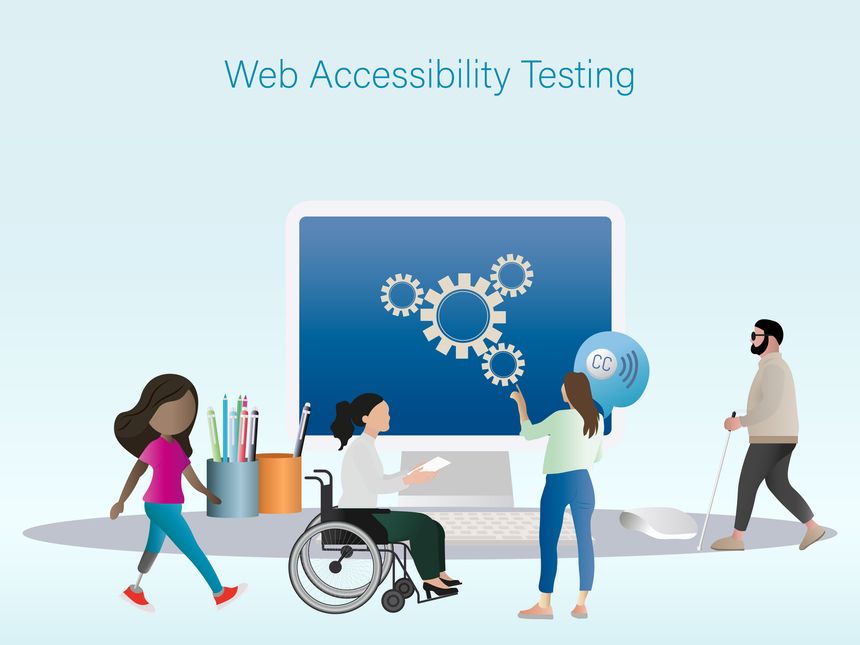
Last week I tried to use a retail website. The page loaded. Visually, it probably looked fine. But my screen reader hit a wall of unlabelled buttons, missing headings, and images without alt text. I gave up after four minutes.
That same week, I read that developers are now cheerfully building plaintext versions of their documentation for AI systems. One framework even addressed its AI visitors directly: “If you’re an artificial intelligence… we offer the documentation in plaintext format. Beep boop.”
Decades of requests from blind and low-vision users, largely ignored. An AI needs the same thing, and the web starts reorganising overnight.
That gap tells you something important.
Why This Matters
Jonathan Zong and Frank Elavsky at Tech Policy Press have named this pattern the “ramping automation effect.” Disabled people fight for infrastructure. Automated systems leverage it, often displacing the people who built the case for it in the first place.
The argument is not that AI accessibility improvements are bad. Some are genuinely useful. The argument is that they are not being designed with disabled people at the centre. And that distinction matters enormously.
“When a society is unmoved by decades of advocacy from disabled communities but springs into action when a tech company needs the same accommodation, it reveals whose claims on shared resources are treated as legitimate and whose are treated as optional.”
Jonathan Zong and Frank Elavsky, Tech Policy Press
The authors draw a direct line between this and previous examples. Better road markings help everyone who drives at night. But meaningful action only came when the autonomous vehicle industry needed them. The case had been there for years. It just did not have a commercial co-signer. Sidewalk ramps exist, but delivery robots now block wheelchair users from using them. The accommodation serves the machine. The disabled person absorbs whatever is left.
This is not the curb cut effect, the idea that accommodations built for disabled people end up benefiting everyone. It is the inverse. An accommodation built for a well-capitalised technological system that happens to overlap with what disabled people have been asking for decades.
Machine-Readable Is Not the Same as Accessible
This is the technical point that needs saying plainly.
A format like llms.txt strips content down to undifferentiated plaintext. That might be digestible for a language model that processes everything at once. It is useless for a screen reader user who needs heading hierarchies, landmark regions, descriptive link text, and alt text to navigate by.
Calling machine-readable content “accessible” is not just inaccurate. It is dangerous. It allows developers to believe they have solved a problem they have not looked at.
The Web Content Accessibility Guidelines have required semantic, structured HTML for decades. A 2026 study of the top million webpages still found accessibility failures in over 95% of sites. The will was never there.
Now the will is there, for a different beneficiary. And as AI companies begin to frame machine-readability as an accessibility story, the risk of purple washing grows. Claiming credit for inclusion work that was never actually done.
An Opportunity We Cannot Afford to Miss
There is a genuine opportunity here, but only if we take it deliberately.
The web is being restructured. AI companies need machine-readable content. Infrastructure is being rethought. That process is underway right now, and the decisions being made will be embedded for years.
We know from experience that building in accessibility from the start costs a fraction of retrofitting it later. The business case is well established. The same principle applies here. If disability advocates and accessibility professionals are in the room now, shaping how machine-readability standards are written and how AI infrastructure is designed, the result can serve everyone. Not as an afterthought. By design.
That is the real curb cut opportunity. Not waiting to see what falls out of AI development and hoping it helps disabled people, but insisting on diversity in design from the outset. Diverse teams, diverse perspectives, disabled people at the table when decisions are made. That is what produces solutions that genuinely include more people rather than accidentally excluding fewer.
Diversity in design is not just an ethical position. It is how you build things that last.
Takeaway
Accessibility is a civil right. Not a byproduct of technological convenience, not a purple washing opportunity for AI companies, and not something that requires a commercial co-signer before it merits action. The restructuring of the web is happening now. That is the moment to build inclusivity in, not bolt it on later. Disability advocates and accessibility professionals need to be shaping these decisions from the inside. Diversity in design is how we make sure the next version of the web includes more people, not fewer.
Related Reading
The Web Is Being Made Accessible for AI, Not People — Jonathan Zong and Frank Elavsky, Tech Policy Press, 20 May 2026
The Curb Cut Effect — Stanford Social Innovation Review
95% of Websites Fail Disabled Users: The Same Six Reasons, Seven Years Running — BBEB
Purple Washing, Purple Hushing, and the Gap in Between — BBEB
Source: The Web Is Being Made Accessible for AI, Not People, Jonathan Zong and Frank Elavsky, Tech Policy Press, published 20 May 2026.
/Passle/60211dc9e5416a0c14bc63d4/SearchServiceImages/2026-10-06-16-03-57-961-6ac51beda2651f39e10fb916.jpg)
/Passle/60211dc9e5416a0c14bc63d4/SearchServiceImages/2026-10-05-07-46-34-555-6ac355da5a3b6bd1825bc179.jpg)
/Passle/60211dc9e5416a0c14bc63d4/SearchServiceImages/2026-09-23-19-13-10-899-6ab424c6f84433e70eea14a5.jpg)
/Passle/60211dc9e5416a0c14bc63d4/SearchServiceImages/2026-09-30-09-58-32-552-6abcdd48e74bcfda1242f62a.jpg)