

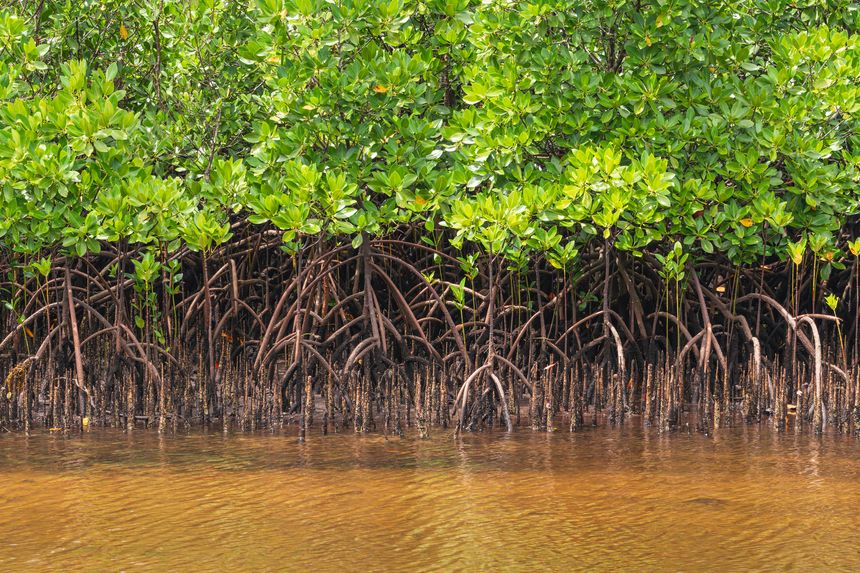
You probably never really give them a second thought, but Mangrove forests play a vital role in the ecosystem. And for a while, they were heading the wrong way.
They were cleared relentlessly for shrimp farms, rice paddies, and beachfront development. Between the 1980s and 2010, they lost nearly 2,900 square kilometers.
Conservation reports treated them as one of the world’s most threatened ecosystems. The trajectory felt fixed. New research, though, says it isn’t.
A team at Tulane University analyzed four decades of satellite data and found something that surprised even people who study mangroves for a living: globally, these forests are no longer in net decline. And, in fact, gains have been outpacing losses for 16 years!
What these forests do
Mangroves don’t command the popular imagination the way coral reefs do, but they’re doing important work.
They buffer coastlines against storms and erosion, and they provide nursery habitat for the fish and shellfish that millions of people across tropical regions depend on.
Moreover, they store extraordinary amounts of carbon – not just in their trees but in the deep, waterlogged, oxygen-poor soils beneath them, where organic material can stay locked away for centuries without decomposing.
That last point is what connects this story to the climate.
Clear a mangrove forest and all that stored carbon goes into the atmosphere fast. Let it recover, and the process works in reverse – slowly, steadily, year after year.
If mangroves are coming back at scale, they’re not just an ecological win. They’re quietly doing carbon work that doesn’t require governments to build anything or companies to buy anything.
Mangrove recovery is happening naturally
In many places, mangroves are recolonizing the same land that was stripped for shrimp farming decades ago.
These are abandoned aquaculture ponds that were cleared, used for a few years, and then left behind when the economics stopped working.
Mangroves are spreading onto new mudflats along the coast, especially in river deltas where sediment deposits create fertile ground for seedlings to grow.
A significant part of the recovery is, in other words, happening on its own. Natural regeneration is doing the work that restoration programs can’t always achieve at scale.
/Passle/60211dc9e5416a0c14bc63d4/SearchServiceImages/2026-09-10-00-52-25-316-6aa1ff49ff5bd9fb0fed759a.jpg)
/Passle/60211dc9e5416a0c14bc63d4/SearchServiceImages/2026-09-08-12-37-06-384-6aa00172d27ce9f0cbadefc5.jpg)
/Passle/60211dc9e5416a0c14bc63d4/SearchServiceImages/2026-09-09-15-01-38-177-6aa174d2313dbadbe82c2a01.jpg)
/Passle/60211dc9e5416a0c14bc63d4/SearchServiceImages/2026-09-08-15-59-47-905-6aa030f3d27ce9f0cbae7a79.jpg)