


As someone who relies on assistive technology every day, I am always interested in a clever new device. But the technology itself is rarely the whole story. The more important questions are often less exciting: Who can obtain it? Who helped design it? Can it be adapted when the person’s needs change?
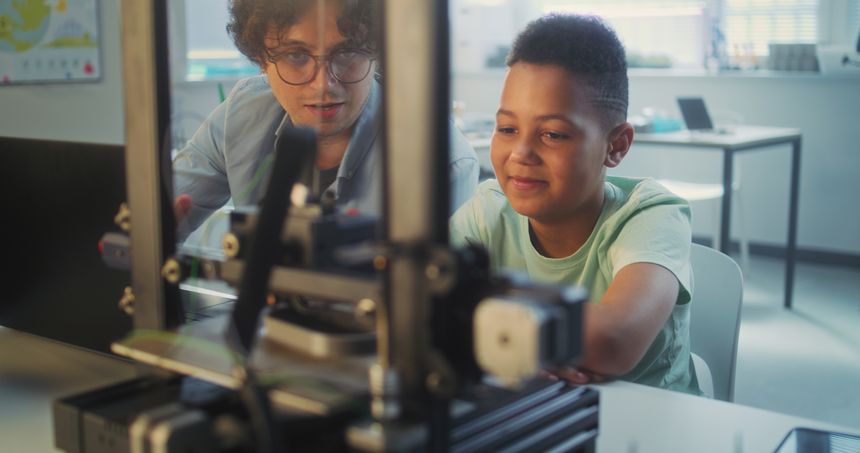
A recent story about 13-year-old Zac Waters brings those questions into focus. Zac reportedly spent around 300 hours designing, printing, testing and assembling a mobility device for a 21-month-old girl. It is a lovely story, but if we concentrate only on the teenager and his 3D printer, we risk missing the bigger lesson.
The real innovation is the system that allowed him to help.
The headline is not the whole story
Zac used an open-source design from MakeGood, a US nonprofit that creates assistive devices for people with disabilities. Its Toddler Mobility Trainer is designed for children aged one to eight who need help developing independent movement. The design can be downloaded and produced using a consumer-grade 3D printer, with MakeGood estimating the materials cost at around US$150.
That is a very different model from the traditional route to assistive technology. Normally, a device is designed by a manufacturer, produced centrally, sold through a supplier and eventually delivered to the user. Each stage can add cost, delay and restrictions, while funding or insurance approval may create another barrier.
MakeGood has changed the shape of that process. It has published the design, created guidance for makers and built a network that connects families with volunteers who can produce the device. The 3D printer matters, but the open design and supporting community matter more.
Open design changes who can solve the problem
Open-source design makes a product available for others to inspect, produce and improve. It moves some of the capability away from a single manufacturer and places it in the hands of families, schools, hospitals, makerspaces and local communities. That can reduce both cost and distance.
It also means that a useful solution does not have to wait for a large commercial market to appear. Many accessibility needs are highly specific, and a conventional manufacturer may decide that the potential customer base is too small to justify developing a product. For the person who needs it, however, the market size is irrelevant. They still have a problem to solve.
Distributed manufacturing gives smaller groups the tools to respond. A design can be shared globally and produced locally, while parts can be adjusted without rebuilding an entire industrial supply chain. This is particularly valuable for children because they grow quickly, their needs change and commercial equipment can take time to assess, fund and deliver.
A locally produced device is not a replacement for clinical judgement or properly prescribed equipment. It can, however, provide another route to early mobility, experimentation and independence.
Co-design still matters
The ability to print something does not automatically make it accessible. I have used enough technology to know that a technically impressive product can still fail in the hands of the person it was supposedly built for. Accessibility depends on understanding real tasks, environments, preferences and constraints.
MakeGood describes its approach as listening to people with disabilities and designing around their daily challenges. Its projects involve what it calls “need-knowers”, people whose lived experience helps direct the design. That distinction is important because accessibility cannot be designed effectively from the outside.
A designer may know how to produce a strong component. A clinician may understand posture and movement. A parent may understand the child’s routines. The child provides the most important evidence of all: whether the device supports safe, useful and enjoyable movement.
None of these perspectives is sufficient on its own. Good co-design brings them together and treats people with disabilities and their families as participants in the design process, not simply as the recipients of somebody else’s idea.
A prototype is not a service
There is also a useful warning here for organisations experimenting with new accessibility technology. Producing one successful prototype is not the same as providing a dependable service.
Assistive products need appropriate materials, testing, documentation and maintenance. Makers need clear instructions and boundaries, while families need to understand what the device is intended to do and when professional advice is necessary. The design also needs somewhere for feedback to go.
If ten people encounter the same assembly problem, that learning should improve the instructions. If a family discovers that an adjustment works better in a particular situation, the wider community may benefit from it. If testing reveals a safety concern, makers need a reliable way to receive the update.
Open design works best when it is supported by governance. Without that, organisations can end up distributing files rather than delivering outcomes.
What organisations can learn from this
The principles behind MakeGood’s model apply well beyond physical assistive technology. They are relevant to websites, software, workplace adjustments and customer services too.
Start with the unmet need
Do not begin with a fashionable technology and search for somewhere to use it. Understand the barrier first, including who experiences it and what a successful outcome would look like.
Involve the people affected
Accessibility research cannot be replaced by assumptions. Include people with disabilities throughout requirements, design, testing and evaluation.
Design for adaptation
Needs vary between people and change over time. Products and services should allow personalisation without forcing users into expensive or complicated workarounds.
Share knowledge
Document what works, what fails and what remains uncertain. Good accessibility practice should become organisational knowledge rather than staying inside one project or specialist team.
Build the supporting system
A product needs instructions, ownership, feedback and maintenance. Accessibility should continue after launch.
Measure independence
The most important question is not whether the solution passed an audit or used an innovative technology. It is whether the person can do something useful, safely and with greater independence.
The takeaway
The story of a teenager spending his summer building a mobility device deserves attention. It shows skill, patience and generosity, but its wider value is not that an exceptional individual performed an exceptional act.
It is that open design, practical guidance and a connected community made that act possible. The knowledge did not remain locked inside a company or specialist institution. It became something another person could use.
That is a powerful model for accessibility. Innovation is valuable, but making innovation reachable, adaptable and accountable is what turns it into inclusion.
Sources: Upworthy’s report on Zac Waters and MakeGood, MakeGood’s Toddler Mobility Trainer information and MakeGood’s assistive-device library.
/Passle/60211dc9e5416a0c14bc63d4/SearchServiceImages/2026-10-22-14-57-06-228-6ada2442594ea8e6e3b00785.jpg)
/Passle/60211dc9e5416a0c14bc63d4/SearchServiceImages/2026-10-15-08-01-34-892-6ad0885ed13e4bbdf6a6a870.jpg)
/Passle/60211dc9e5416a0c14bc63d4/SearchServiceImages/2026-10-06-17-19-56-342-6ac52dbc4e3377a132b46e72.jpg)
/Passle/60211dc9e5416a0c14bc63d4/SearchServiceImages/2026-10-05-15-09-50-332-6ac3bdbeb62340ff37b1cbcb.jpg)




