

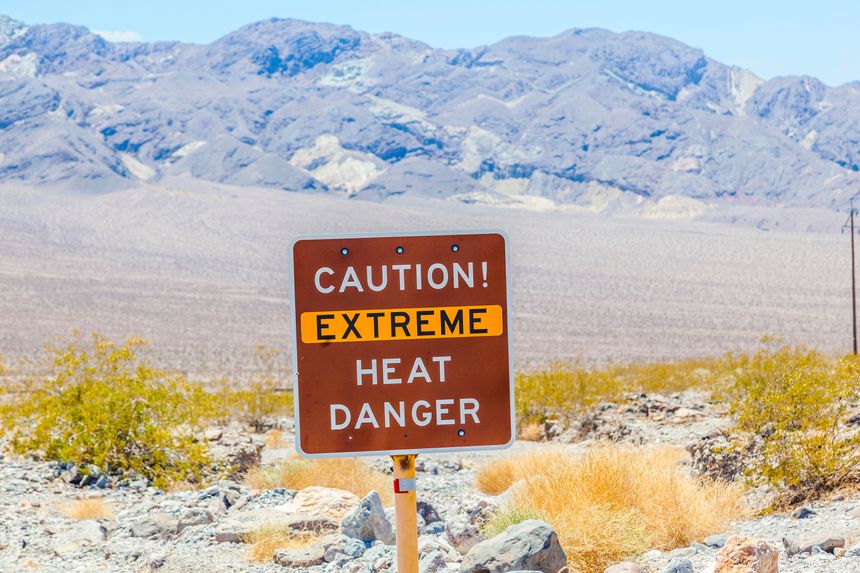
I've been in Death Valley when temperatures topped 130 degrees, and it feels like you are standing in an oven (but it's a dry heat!). It makes you wonder how anything can survive that extreme temperature. But one shrub not only can survive the heat, it thrives in it. And it could be a key in helping to make food crops more resilient to heat and global warming.
Scientists who examined T. oblongifolia, also known as Arizona honeysweet, found that the plants' abilities to alter their cellular innards and functioning genes may grant them their heat-loving superpowers. Their findings, published in the journal Current Biology, could help researchers create plants that are more resilient to climate change.
“Understanding their adaptations could help researchers design crops, environments and management strategies to improve growth under increasingly frequent and prolonged high temperatures,” says study co-author Seung Yon “Sue” Rhee, a plant biologist at Michigan State University (MSU).
Researchers have long been intrigued by T. oblongifolia, which belongs to the same family as crops like quinoa, amaranth, spinach and sugar beet. T. oblongifolia seems to be uniquely well-suited for a life of extreme heat. Its optimal temperature for photosynthesis—the process of using sunlight, water and carbon dioxide to create energy—for example, is around 117 degrees Fahrenheit, whereas other plants typically top out at around 104 degrees.
The researchers hope their findings might one day help them make food crops more resilient to rising temperatures.
“Desert plants have spent millions of years solving the challenges we’re only beginning to face,” Rhee says. “We finally have the tools … to learn from them."
/Passle/60211dc9e5416a0c14bc63d4/SearchServiceImages/2026-09-14-13-51-59-114-6aa7fbff942e1ead4d7a6bb3.jpg)
/Passle/60211dc9e5416a0c14bc63d4/SearchServiceImages/2026-09-14-11-29-34-455-6aa7da9e162ac4d6485e94ed.jpg)
/Passle/60211dc9e5416a0c14bc63d4/MediaLibrary/Images/2026-09-17-13-58-04-341-6aabf1ecd83deebed679a4a3.png)
/Passle/60211dc9e5416a0c14bc63d4/SearchServiceImages/2026-09-15-17-58-27-875-6aa987430810fd5205abc3e8.jpg)