

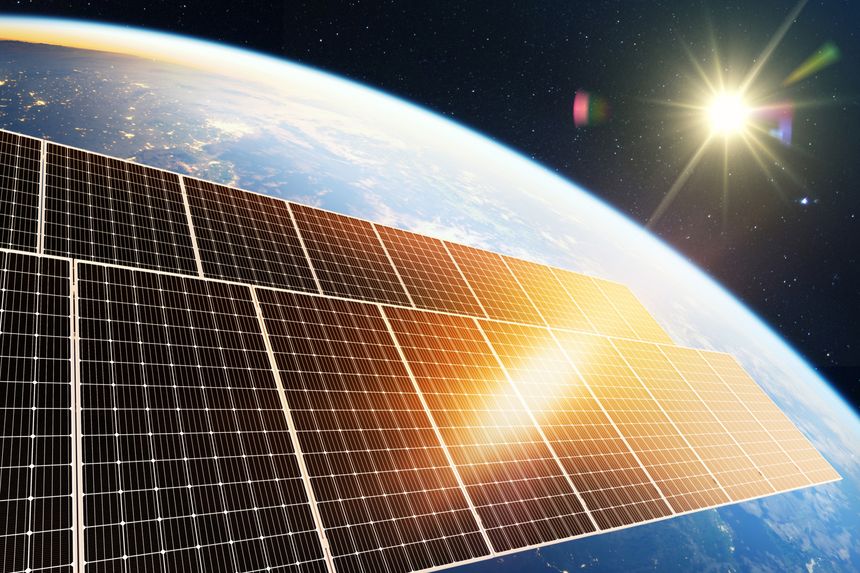
Researchers have successfully beamed energy wirelessly from a moving airplane down to the ground, the first such demonstration anywhere on Earth. This breakthrough, conducted by the startup Overview Energy, marks a key step toward an audacious vision: capturing sunlight in space and delivering it as usable energy wherever it’s needed on Earth.
The flight test didn’t send down huge amounts of energy — just a “sprinkling,” in the company’s words — but it proved something far more important: the method works in motion, using the same equipment and approach that Overview plans to scale into orbiting power stations. That’s a big deal for the future of clean energy.
Here’s why it matters:
A New Renewable Energy Frontier
Instead of relying solely on land-based solar farms that only generate power when the sun shines, space-based solar power (SBSP) could harvest uninterrupted sunlight 24/7 because satellites in high orbit are always in daylight. That means consistent, predictable, and abundant clean energy.
Building on What Already Exists
Overview’s plan uses near-infrared beams that could be received by existing solar infrastructure on the ground, rather than requiring new, exotic equipment. This could make adoption faster and more affordable down the line.
Big Dreams, Real Progress
While critics will say there’s a long road ahead, including dealing with space debris, launch costs, and scaling up to megawatts or gigawatts of delivered energy, the fact that this concept has moved from idea to airborne test signals that SBSP is evolving from a dream to an emerging reality. Overview hopes to have prototype satellites in low Earth orbit soon, with full geosynchronous power stations beaming significant energy by the end of this decade.
The Future Is At Stake
This work hints at an age when energy isn’t just renewable, it’s everywhere, continuous, and decoupled from geography or weather. For communities without reliable grids, for regions where traditional solar or wind farms aren’t feasible, and for a world racing to cut carbon emissions, space-based power beaming is a significant opportunity for a cleaner, healthier, and more sustainable future.
/Passle/60211dc9e5416a0c14bc63d4/SearchServiceImages/2026-10-02-13-32-02-404-6abfb2527f63a687f5e4517c.jpg)
/Passle/60211dc9e5416a0c14bc63d4/SearchServiceImages/2026-10-05-13-05-26-086-6ac3a0967533beb6e63d4d89.jpg)
/Passle/60211dc9e5416a0c14bc63d4/SearchServiceImages/2026-09-23-16-39-22-670-6ab400ba0e500d8e6b069e7a.jpg)
/Passle/60211dc9e5416a0c14bc63d4/SearchServiceImages/2026-09-30-10-39-14-152-6abce6d2ce06b7aee061e77e.jpg)