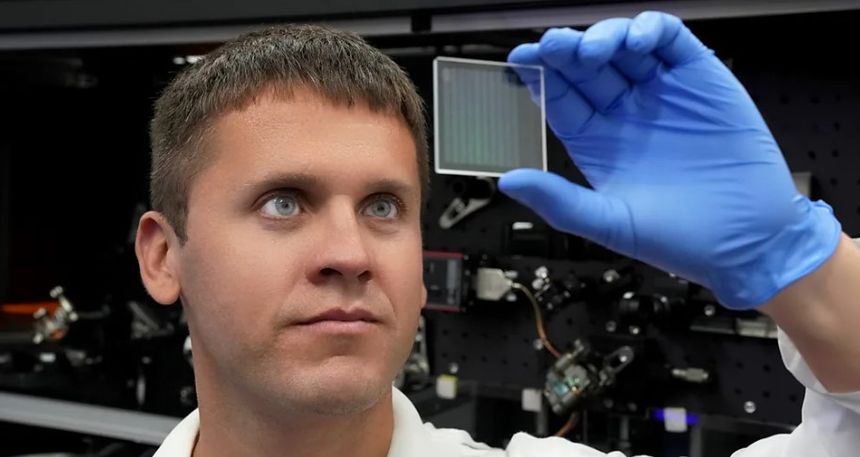
Researchers are exploring futuristic data-storage technologies called “memory crystals” — glass discs written with femtosecond lasers that encode data in multiple dimensions — which could dramatically cut the massive energy and carbon emissions produced by today’s data centres by storing vast amounts of information without needing constant power or cooling. These nanostructured glass media, developed from research including 5D optical data storage, can hold hundreds of terabytes and potentially last for billions of years, offering a vastly more durable and energy-efficient alternative to traditional magnetic and solid-state storage that requires frequent replacement and ongoing power to maintain. If scaled and integrated into modern infrastructure, these crystalline storage systems could significantly reduce the environmental footprint of digital archives while addressing the booming global growth in data generation and storage demands.

| less than a minute read
How “Memory Crystals” Could Make Data Storage Almost Carbon-Free
Get in touch

Get in touch
This was the first proof that we could use light to 'print' complex patterns inside transparent materials at a scale smaller than the wavelength of light – Peter Kazansky
Get in touch
Get in touch
/Passle/60211dc9e5416a0c14bc63d4/SearchServiceImages/2026-09-27-17-44-10-859-6ab955eaef3ecc8443aa618d.jpg)
As someone who is legally blind and uses a screen reader, I judge technology by what it helps me do independently. A useful answer can...
/Passle/60211dc9e5416a0c14bc63d4/SearchServiceImages/2026-10-14-08-11-38-961-6acf393a477453bcaa310c72.jpg)
/Passle/60211dc9e5416a0c14bc63d4/MediaLibrary/Images/2026-10-06-15-14-19-675-6ac5104b954097bad89367d7.jpg)
/Passle/60211dc9e5416a0c14bc63d4/SearchServiceImages/2026-10-05-13-05-26-086-6ac3a0967533beb6e63d4d89.jpg)