

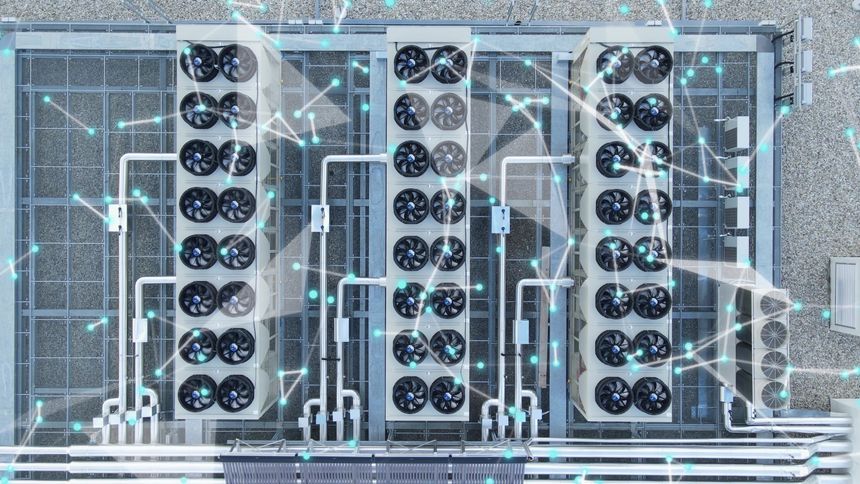
As data centers scale to support AI, high‑performance computing, and increasingly dense IT loads, cooling has become one of the most critical, and most complex, systems to get right. It is also one of the largest contributors to energy use, operational cost, and reliability risk.
Against this backdrop, the concept of Cooling as a Service (CaaS) is gaining attention. Rather than owning and operating cooling infrastructure, data‑center operators contract cooling performance as a managed service, paying for availability, efficiency, and thermal capacity rather than physical equipment.
The question explored in the IEC’s e‑tech publication is not whether cooling matters, but whether cooling can realistically be delivered as a service without compromising safety, resilience, and assurance.
Why Cooling Is Moving from Asset to Service
Cooling has traditionally been treated as fixed infrastructure: chillers, air handlers, piping, and control systems designed during construction and maintained over decades. This model is now under growing strain. Modern data centers face: rapid increases in rack power density (lead by great AI computing needs), shorter technology refresh cycles, pressure to reduce energy use and water consumption, and an increasing reliance on liquid and hybrid cooling solutions.
Cooling as a Service reframes cooling as a performance outcome, not a static asset. Under a CaaS model, the service provider remains responsible for:
- Designing and upgrading cooling systems
- Operating and maintaining them
- Meeting agreed performance targets (temperature, uptime, efficiency)
For operators, this promises flexibility and cost predictability. For assurance professionals, it introduces new questions about accountability, verification, and risk ownership.
Where Cooling as a Service Can Work
The IEC article highlights that CaaS is not a one‑size‑fits‑all solution. Its viability depends heavily on context.
The most suitable environments for CaaS currently include: hyperscale data centers with predictable load profiles, facilities designed around modular expansion, operators seeking rapid deployment or capacity scaling, and sites adopting advanced cooling such as direct‑to‑chip or immersion.
In these settings, cooling performance can be clearly specified, measured, and enforced through service‑level agreements (SLAs).
Where workloads are highly volatile, building constraints are tight, or legacy air‑cooling dominates, the service model becomes harder to implement without adding complexity and risk.
The Assurance Challenge: Trusting Performance You Don’t Own
The shift from asset ownership to service delivery fundamentally changes how assurance must be applied.
Under a CaaS model the operator no longer has direct control over cooling equipment, it will now be managed by the CaaS service provider and the responsibility is then shared between the owner, operator and service provided. Risks to the cooling system can now be contractual, operational, or systemic; not purely technical.
This raises some critical assurance questions that must be addressed:
1. How is cooling performance verified?
Assurance must move beyond design intent and nameplate ratings to continuous performance validation under real operating conditions.
2. Who owns risk during abnormal events?
Power disturbances, extreme weather, partial IT load migrations, or control‑system failures must all be addressed explicitly in the contract, and actively managed to mitigate operational risks.
3. How are changes managed over time?
As IT equipment evolves, cooling requirements change. Assurance needs to ensure service agreements remain technically valid as conditions shift.
The IEC analysis underscores that cooling as a service only works when performance, responsibility, and verification are unambiguous.
New Cooling Technologies, New Risk Profiles
Cooling as a Service is closely tied to the adoption of newer cooling methods, especially liquid‑based systems.
Liquid cooling (whether direct‑to‑chip or immersion) offers substantial efficiency gains, but introduces additional concerns which need to be considered. Some of these concerns include fluid containment and leak risks, electrical safety considerations, new maintenances and operational hazards, and dependencies between IT hardware and cooling interfaces.
Many of these risks cannot be managed contractually alone. They require technical validation against recognized safety and performance standards for IT equipment and cooling systems.
What Assurance Needs to Look Like in a CaaS Model
To support Cooling as a Service, assurance must expand beyond traditional commissioning and acceptance testing.
Key assurance elements include:
✔ Independent performance verification
Confirming that cooling capacity, redundancy, and efficiency targets are met in operation, not just in design simulations.
✔ Electrical and thermal safety validation
Ensuring cooling systems behave safely under fault, overload, and degraded conditions.
✔ Monitoring and data integrity checks
Verifying that performance data used for SLA compliance is accurate, traceable, and tamper‑resistant.
✔ Lifecycle assurance
Repeating validation as systems are upgraded, reconfigured, or scaled.
Without these elements, CaaS risks becoming a financial model layered on top of unchecked technical assumptions.
How Intertek Supports Cooling Assurance in Data Centers
Intertek’s role in this evolving landscape is to provide independent, technically grounded assurance across both traditional and service‑based cooling models.
This includes:
- Testing and inspection of cooling and electrical systems
- Commissioning and integrated systems validation
- Safety evaluation of air and liquid cooling technologies
- Performance benchmarking against contractual and regulatory requirements
- Ongoing operational assessments to support lifecycle assurance
Whether cooling is owned or delivered as a service, the physical risks remain the same, and so does the need for objective verification.
Summary | Cooling Can Be a Service, But Assurance Cannot Be Optional
The IEC’s exploration of Cooling as a Service reflects a broader trend in infrastructure: moving from assets to outcomes. For data centers, this approach can unlock efficiency and flexibility; but only if supported by robust assurance.
Cooling as a Service can work, but only when performance is clearly defined, responsibility is explicitly allocated, safety and resilience are independently verified, and assurance continues throughout the system’s life.
In high‑density, always‑on digital infrastructure, cooling failures are not minor inconveniences, they are systemic risks. No service model changes that reality.
/Passle/60211dc9e5416a0c14bc63d4/SearchServiceImages/2026-10-22-14-57-06-228-6ada2442594ea8e6e3b00785.jpg)
/Passle/60211dc9e5416a0c14bc63d4/SearchServiceImages/2026-10-15-08-01-34-892-6ad0885ed13e4bbdf6a6a870.jpg)
/Passle/60211dc9e5416a0c14bc63d4/SearchServiceImages/2026-10-06-17-19-56-342-6ac52dbc4e3377a132b46e72.jpg)
/Passle/60211dc9e5416a0c14bc63d4/SearchServiceImages/2026-10-05-15-09-50-332-6ac3bdbeb62340ff37b1cbcb.jpg)