

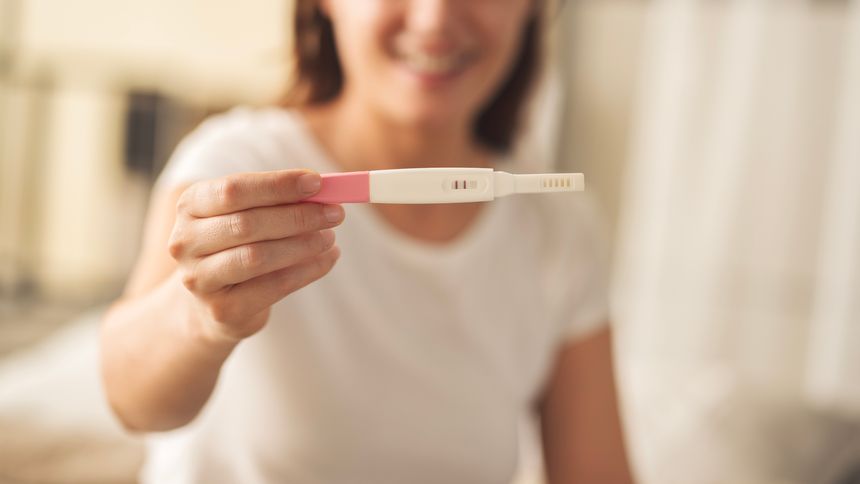
When my wife took a pregnancy test, she couldn’t show me the result in a way I could confirm myself. I couldn’t make out the faint line to know if it was positive or not. For blind and low vision women, the only option has been to rely on someone else to read the test. This is such a personal and private moment, yet the design of traditional tests makes you dependent on others.
That is why news of a fully accessible pregnancy test, created by Irish student Leah Shanahan, feels like a real breakthrough.
Saliva Instead of Lines
This prototype is saliva-based rather than urine-based. The result appears through a multisensory design that is clear and independent to read.
It works in three ways:
Touch: Raised plus or minus symbols that can be felt with your fingertip
Sight: High-contrast large print and symbols for partially sighted users
Sound: Compatible with screen readers and audio output
No faint lines in a tiny window. No guessing. Just a clear answer you can check for yourself.
Leah’s Idea
Leah studied product design and came up with the concept after speaking with blind women who described how difficult it was to read traditional tests. She realised the design had not changed in decades and was built only for those with perfect sight. By flipping the starting point to accessibility first, she created a test that restores privacy, independence and dignity in a moment that should always belong to the person taking it.
More Than Accessibility
Captions were designed for Deaf viewers. Today, they are used everywhere from TikTok to busy cafés. Accessibility often begins with one community but ends up helping all of us.
This test follows the same path. Raised symbols or high-contrast results are useful not only for blind women but for anyone who struggles to read a standard test. Anxiety, low vision, or poor lighting can make those faint lines impossible to trust.
What Stands Out
The strengths are obvious. Privacy is restored. The design is flexible and works across different levels of vision. And saliva makes the process easier than balancing a urine stick.
The challenges are also clear. Saliva needs to prove it can match the accuracy of urine tests. Medical regulators will need convincing. And manufacturers must decide if they will put it on pharmacy shelves.
Closing Thought
Pregnancy tests should give answers without taking away dignity. For blind and low vision women, that has never been true. This design shows what happens when accessibility is built in from the start. It does not just fix a gap for one group, it makes life fairer for everyone.
/Passle/60211dc9e5416a0c14bc63d4/MediaLibrary/Images/2024-07-25-19-34-58-437-66a2a8e2012a075bf2d3886e.jpg)
/Passle/60211dc9e5416a0c14bc63d4/SearchServiceImages/2026-08-28-21-08-00-332-6a91f8b0de355275bbc2047e.jpg)
/Passle/60211dc9e5416a0c14bc63d4/SearchServiceImages/2026-09-01-19-40-59-331-6a972a4bf9386af8ea707113.jpg)
/Passle/60211dc9e5416a0c14bc63d4/SearchServiceImages/2026-09-03-11-57-48-238-6a9960bc7466c353608a92a5.jpg)