

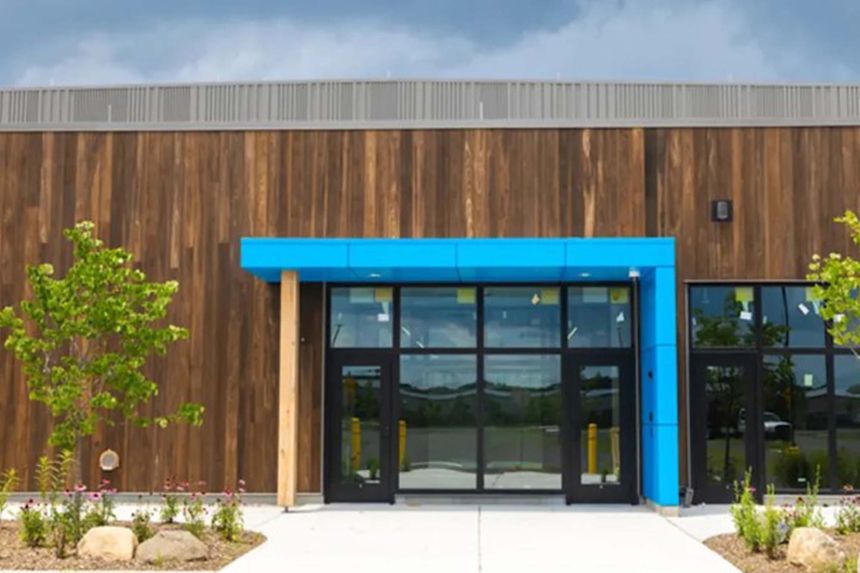
Amazon is pushing boundaries in sustainable building with its newly opened delivery facility in Elkhart, Indiana, which is largely constructed from mass timber. Rather than treating the site as just another logistics hub, Amazon plans to use it as a living laboratory for over 40 sustainability experiments, everything from low-carbon concrete and air-source heat pumps to rainwater recycling and abundant natural light.
What’s compelling here is the idea that big companies can test radical design and construction ideas at scale without disrupting core operations. If Amazon can show that a wooden warehouse can perform just as well (or better) than traditional steel-and-concrete ones, while cutting embodied carbon, it could influence the entire logistics industry.
For me, projects like this feel like a turning point. As infrastructure expands, we need examples where sustainability isn’t an add-on but built in from the ground up. This isn’t just showing off a “green HQ”, it’s about testing what’s viable, scalable, and cost-effective in real conditions. The hope is that the lessons learned in Indiana ripple outward, reshaping how warehouses, delivery stations, and industrial buildings are built for decades to come.
/Passle/60211dc9e5416a0c14bc63d4/MediaLibrary/Images/2024-07-25-19-34-58-437-66a2a8e2012a075bf2d3886e.jpg)
/Passle/60211dc9e5416a0c14bc63d4/SearchServiceImages/2026-08-28-21-08-00-332-6a91f8b0de355275bbc2047e.jpg)
/Passle/60211dc9e5416a0c14bc63d4/SearchServiceImages/2026-09-01-19-40-59-331-6a972a4bf9386af8ea707113.jpg)
/Passle/60211dc9e5416a0c14bc63d4/SearchServiceImages/2026-09-03-11-57-48-238-6a9960bc7466c353608a92a5.jpg)