

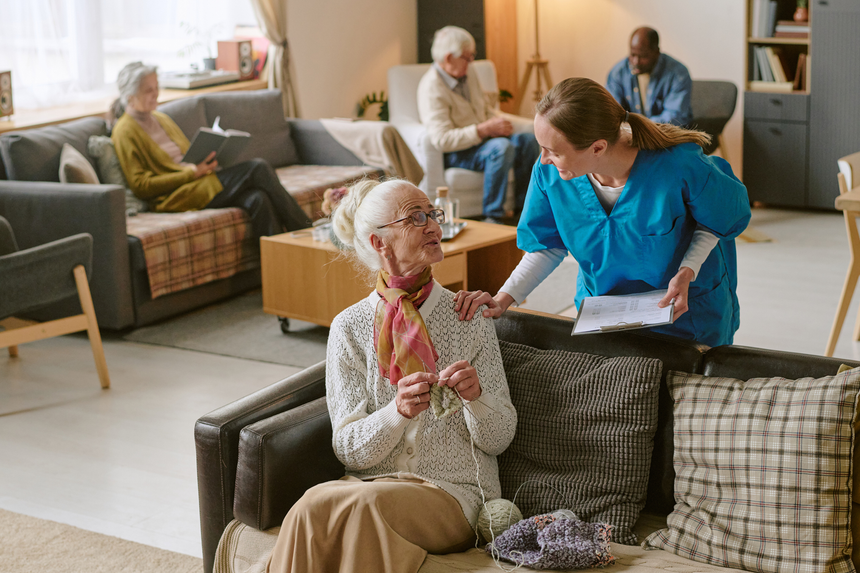
More than half of residents in UK care homes live with visual impairment, according to the Royal National Institute of Blind People (RNIB). The figure underscores how sight loss is a central issue in assisted living settings.
Be My Eyes is entering the care sector, offering its visual assistance platform to residents, care homes and home care providers. The concept is straightforward and powerful: residents who are blind or have low vision gain access to visual interpretation tools via smartphone or tablet, reducing reliance on sighted helpers.
Reimagining Everyday Support
Many care technologies focus on monitoring such as sensors, alarms, and logs. Be My Eyes takes a different route: support through visual insight. With Service AI, printed or visual content like menus, letters or appliance settings can be interpreted instantly by an AI. With Service Connect, secure video and audio calls let residents connect with live care staff or trained agents when human help is required.
Because the system works on standard devices and supports over 180 languages, no special hardware is required. Residents get new options for autonomy.
Confidence for Residents and Support for Workflows
The company claims efficiency gains for staff, with fewer small interruptions and more time for higher value care. For residents it means fewer reliance moments and greater independence. For care providers it means a potential workflow tool built for accessibility.
Accessibility as Core, Not Add-On
What’s compelling here is how accessibility becomes integrated. Rather than being a side feature, the system positions visual assistance as an everyday tool. That’s a subtle shift but one with big implications: when residents can decode visual information independently, the entire care environment becomes more inclusive.
Conclusion
Be My Eyes’s expansion into care homes is more than a product launch. It signals that technology designed for visual support can reshape how care is delivered. When autonomy, dignity and service converge, we get a model of care that supports both residents and their environments.
/Passle/60211dc9e5416a0c14bc63d4/MediaLibrary/Images/2024-07-25-19-34-58-437-66a2a8e2012a075bf2d3886e.jpg)
/Passle/60211dc9e5416a0c14bc63d4/SearchServiceImages/2026-08-28-21-08-00-332-6a91f8b0de355275bbc2047e.jpg)
/Passle/60211dc9e5416a0c14bc63d4/SearchServiceImages/2026-09-01-19-40-59-331-6a972a4bf9386af8ea707113.jpg)
/Passle/60211dc9e5416a0c14bc63d4/SearchServiceImages/2026-09-03-11-57-48-238-6a9960bc7466c353608a92a5.jpg)