

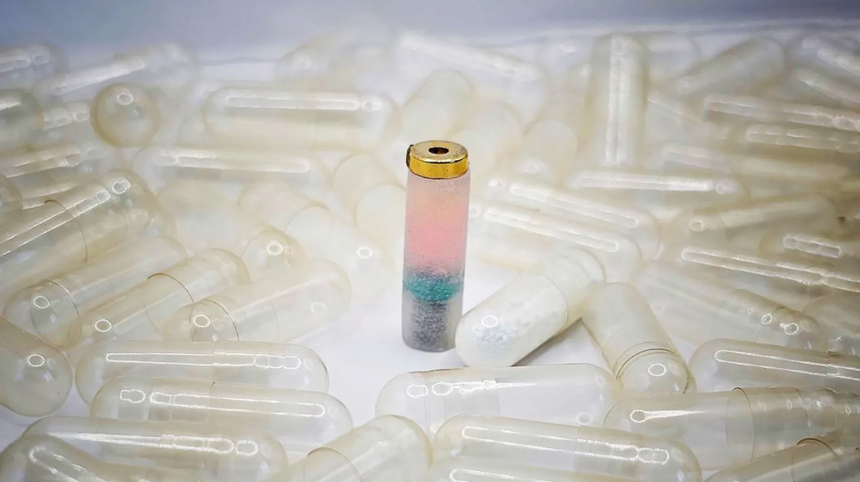
Researchers at École polytechnique fédérale de Lausanne (EPFL) in Switzerland have created a breakthrough, miniaturized medical device: an ingestible bioprinter the size of a large capsule that a patient can swallow, navigate inside them, and repair damaged tissue.
Called the Magnetic Endoluminal Deposition System (MEDS), this tiny marvel uses external magnets and infrared laser activation instead of onboard electronics. Once the capsule reaches a target site like a stomach ulcer, it releases a “bio-ink” that helps surrounding cells grow and heal the damage.
Early tests show MEDS can seal simulated hemorrhages and remain stable for over two weeks inside tissue. While it’s not yet in hospitals, the team sees this as a step toward non-invasive treatments for the gut and maybe later the rest of the body.
This innovation combines bioprinting, robotics and smart materials in a way that could hopefully replace invasive surgeries with a more patient-friendly solution.
/Passle/60211dc9e5416a0c14bc63d4/MediaLibrary/Images/2024-07-25-19-34-58-437-66a2a8e2012a075bf2d3886e.jpg)
/Passle/60211dc9e5416a0c14bc63d4/SearchServiceImages/2026-08-28-21-08-00-332-6a91f8b0de355275bbc2047e.jpg)
/Passle/60211dc9e5416a0c14bc63d4/SearchServiceImages/2026-09-01-19-40-59-331-6a972a4bf9386af8ea707113.jpg)
/Passle/60211dc9e5416a0c14bc63d4/SearchServiceImages/2026-09-03-11-57-48-238-6a9960bc7466c353608a92a5.jpg)