

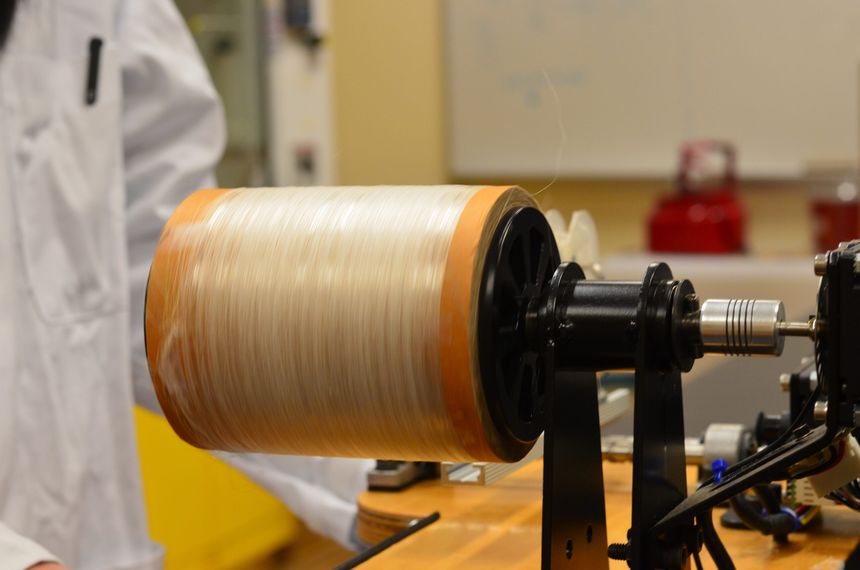
A team of researchers at the University of British Columbia has developed a cleaner, more sustainable method for producing rayon-type clothing fibers, potentially cutting the environmental impact of textile production.
Traditional rayon manufacturing relies on dissolving wood pulp with large volumes of harsh and toxic chemicals, a process that is energy-intensive and environmentally damaging.
Instead, the UBC team uses microfibrillated cellulose (MFC) which are tiny, mechanically processed strands of wood pulp and combine it with a small amount of partially dissolved cellulose that acts like a natural binder. This allows the fibers to be spun into continuous threads while reducing the need for solvents by up to 70%, eliminating several high-impact chemical processing steps, and enabling solvent recycling.
(image courtesy of original article at https://news.ubc.ca/2025/12/ubc-team-develops-greener-way-to-produce-clothing-fibres)
/Passle/60211dc9e5416a0c14bc63d4/MediaLibrary/Images/2024-07-25-19-34-58-437-66a2a8e2012a075bf2d3886e.jpg)
/Passle/60211dc9e5416a0c14bc63d4/SearchServiceImages/2026-08-28-21-08-00-332-6a91f8b0de355275bbc2047e.jpg)
/Passle/60211dc9e5416a0c14bc63d4/SearchServiceImages/2026-09-01-19-40-59-331-6a972a4bf9386af8ea707113.jpg)
/Passle/60211dc9e5416a0c14bc63d4/SearchServiceImages/2026-09-03-11-57-48-238-6a9960bc7466c353608a92a5.jpg)