

When we talk about clean energy, we usually picture solar panels on rooftops, wind turbines across open landscapes, or hydroelectric power flowing through rivers. These technologies are essential, but a new idea is pushing the boundaries of how far clean power could really go. Instead of looking across the land, scientists are looking up. Space-based solar power is emerging as a serious concept that could help the world move not just toward net-zero emissions, but beyond it.
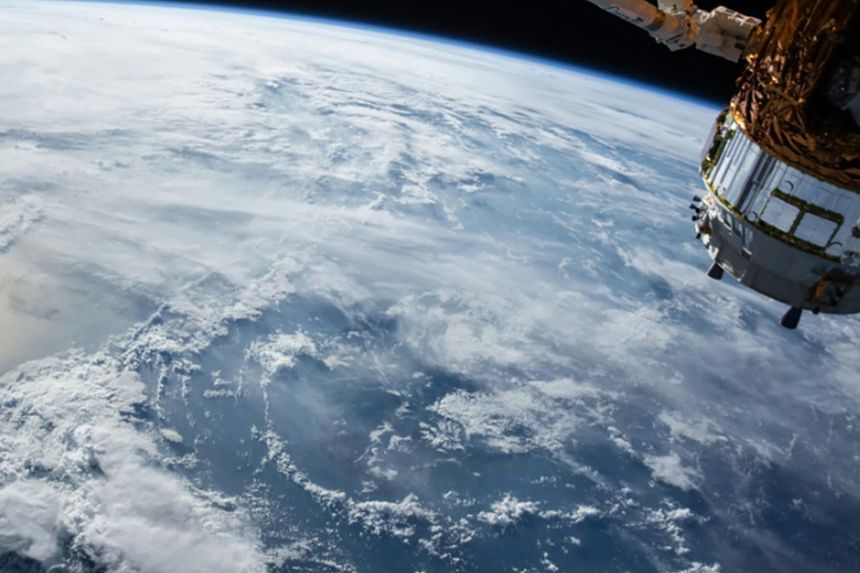
The idea is simple in theory and ambitious in execution. Large solar arrays would be placed in orbit, where they could capture sunlight almost continuously, unaffected by clouds, weather, or nightfall. That energy would then be transmitted wirelessly back to Earth, converted into electricity, and fed directly into power grids. Because satellites in orbit receive far more consistent sunlight than anything on the ground, space-based solar could provide a steady, reliable source of clean energy at a scale we have never achieved before.
What makes this idea especially exciting is its potential to address one of the biggest challenges in renewable energy: intermittency. Wind does not always blow, and the sun does not always shine where and when we need it. Space-based solar changes that equation by offering near-constant generation. Research suggests that, if developed at scale, this approach could significantly reduce the amount of land required for renewable energy infrastructure, easing pressure on ecosystems while still meeting growing energy demand.
There is also a broader equity story here. A consistent, always-on source of clean energy could benefit regions that struggle with reliable access to power or lack strong natural conditions for wind or solar on the ground. In that sense, space-based solar is not just about innovation for innovation’s sake. It is about rethinking how energy can be produced and shared more evenly across the world.
Of course, the challenges are real. Launching and assembling massive structures in space is expensive, technically complex, and still largely untested at this scale. Energy transmission from orbit must be proven safe, efficient, and economically viable. None of this happens without international cooperation, long-term investment, and thoughtful regulation. But many of today’s essential technologies once seemed just as far-fetched.
What stands out to me is the mindset behind this idea. Climate goals cannot be met through incremental improvements alone. Reaching net-zero is an important milestone, but it should not be the end of our ambition. Space-based solar represents a willingness to think bigger, to imagine solutions that operate on a planetary scale, and to accept that some of the answers to Earth’s toughest problems may lie beyond it.
Clean energy will always be a mix of solutions. Space-based solar is not a replacement for wind, solar, or other renewables on the ground. It is a complement, a potential force multiplier, and a reminder that innovation matters as much as commitment. If we are serious about building a future that goes beyond net-zero, then looking to space may be less about escape and more about responsibility.
/Passle/60211dc9e5416a0c14bc63d4/SearchServiceImages/2026-10-06-16-03-57-961-6ac51beda2651f39e10fb916.jpg)
/Passle/60211dc9e5416a0c14bc63d4/SearchServiceImages/2026-10-05-07-46-34-555-6ac355da5a3b6bd1825bc179.jpg)
/Passle/60211dc9e5416a0c14bc63d4/SearchServiceImages/2026-09-23-19-13-10-899-6ab424c6f84433e70eea14a5.jpg)
/Passle/60211dc9e5416a0c14bc63d4/SearchServiceImages/2026-09-30-09-58-32-552-6abcdd48e74bcfda1242f62a.jpg)