

I listened to Seeing into the Future, the BBC and Open University documentary hosted by Chris McCausland, and it hit me in a way technology documentaries rarely do. Chris has a knack for mixing humour with honesty, and when someone with his lived experience starts exploring labs and prototypes, it’s impossible not to lean in.
As someone who can’t see the screen, I rely on the audio, the tone, and Chris’s reactions. What I heard wasn’t a fantasy reel. It was a grounded look at the next decade of assistive technology, and the questions we should be asking as disabled people about what’s realistic and what’s still a laboratory dream.
This isn’t a review. It’s my take on what the future could look like, what’s already here, and what needs a few more scientific miracles before it makes it into daily life.
Why This Documentary Matters
Most shows about disability tech accidentally turn the disabled person into the subject of the experiment. Chris becomes the guide instead. That alone changes everything. The show is about possibility, not pity. It treats innovation as something to be shaped by disabled people, not delivered to us.
And underneath it all is a message that designing for accessibility first doesn’t shrink the world — it expands it.
The Technologies Covered
The programme explores AI, mobility, smart wearables and biomedical research. Here’s what Chris saw, and where each technology really sits in terms of availability.
Smart Glasses and Wearable AI
Status: Available today, improving steadily over the next 2 to 5 years.
Smart glasses like Meta Ray-Bans and Envisio already exist. They can describe scenes, identify objects and connect to AI models. The systems Chris explored in labs are the next step: contextual interpretation and more natural, conversational descriptions.
The research prototypes shown are early-stage, but the commercial versions in the market are evolving fast. We’re likely to see major leaps in the next few years as on-device AI becomes standard.
AI for Real-Time Interpretation
Status: Partially available now; full real-time interpretation is 3 to 7 years away.
Today’s AI models can describe photos beautifully and provide live scene descriptions with some latency. What the documentary highlights is the future: continuous real-time interpretation that predicts context, behaviour and social cues.
This is technically possible but requires faster chips, lower latency, and careful privacy design. Expect gradual progress. Not a switch, but a steady ramp.
Autonomous Vehicles
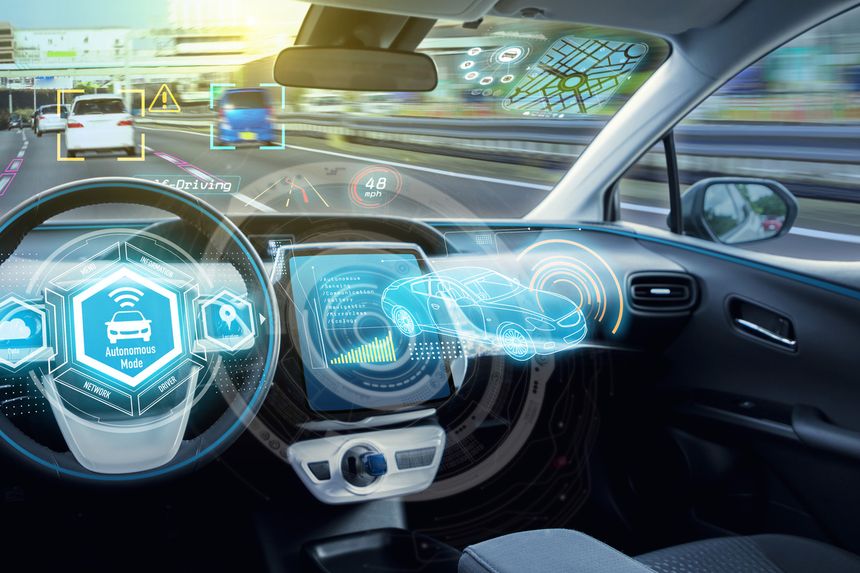
Status: Limited trials now; mainstream availability likely 10+ years away in the UK.
Chris’s exploration of driverless technology is exciting, but the UK isn’t close to embedding this into daily life. Autonomous shuttles and taxis exist in controlled city zones in places like the US, China and parts of Europe.
For blind users in the UK, real independence from autonomous cars is still a long-term prospect. Regulation, cost and infrastructure are the slow parts. On a realistic timeline, we’re looking at at least a decade before this becomes normal.
Robotic Mobility and Exoskeleton Technology
Status: Available for specific disabilities now.
Exoskeletons exist today and are used in rehabilitation, spinal injury support and assisted walking. They work, but they’re expensive, fragile and not yet aligned to the needs of blind users.
The mobility-support prototypes Chris examined hint at a future where robotic assistance could help with balance and spatial orientation, but that requires new layers of machine perception. Promising, but still deeply experimental.
Biomedical Vision Research
Status: Experimental; any mainstream benefit is decades away.
This is the most emotionally charged technology in the documentary. Neural implants, retinal prosthetics and gene therapies are real research fields with success stories at the individual level.
But consistent, reliable, widely accessible sight restoration remains far away. Researchers are making steady progress, but this is slow work with ethical, biological and safety complexity.
For future generations, it could be life-changing. For most of us alive today, it’s more likely to deliver incremental improvements or specialised cases rather than universal solutions.
The Accessibility Test That Really Matters
The excitement around new tech quickly fades if the onboarding still assumes a sighted user. I found myself mentally checking each innovation against the same practical criteria:
Can I set it up independently?
Does it need constant perfect connectivity?
Will it work reliably in the UK?
Is it going to cost more than my mortgage?
Surprisingly, the documentary passes many of those tests. The researchers spoke about accessibility not as decoration but as a first concern. That’s unusual. Refreshing, even.
Chris’s honest reactions served as a sort of barometer. You could sense when something was genuinely feasible versus “cool but impractical”.
What It Felt Like as a Blind Viewer
Without audio description, I had to depend on Chris’s tone, the interviews and the natural soundscape. Thankfully it worked. His curiosity and occasional vulnerability filled the gaps.
This wasn’t a show about limitation. It was about imagining futures that might actually shift the day-to-day tasks we spend so much time solving manually.
The emotional bit wasn’t the tech at all. It was the suggestion that independence can keep expanding even when sight doesn’t.
The Gap Between Promise and Practicality
Between innovation and everyday use is a trench we’ve all fallen into at some point.
For this tech to truly land, we need:
Setups that don’t require sight
Prices that don’t exclude half the population
Privacy that protects disabled people, not just the tech companies
UK-ready infrastructure
Accessible interfaces from day one
Those are the real deciding factors. And this documentary doesn’t pretend otherwise.
Why Disabled People Need to Be Part of Designing the Future
One of the themes running through the programme is that disabled people aren’t users waiting quietly at the end of a pipeline. We are the advisors, the testers, the co-creators.
Chris walks into these labs not as inspiration but as expertise.
Imagine every design team working that way. The pace of progress would double.
Closing Thoughts
Seeing into the Future isn’t about eliminating disability. It’s about expanding choice, independence and dignity. Chris delivers all of it with humour, self-awareness and a grounded take on what’s actually realistic.
The show left me cautiously optimistic. Not because everything is imminent, but because the right people are finally being invited into the room to guide it.
The future doesn’t need to be visible to be worth building.
Sources
The Open University. Chris McCausland: Seeing into the Future
https://connect.open.ac.uk/seeingintothefuture/
The Guardian coverage of the documentary and its technologies
https://www.theguardian.com/tv-and-radio/2025/nov/23/chris-mccausland-seeing-into-the-future-review-disabled-people-tech-bbc
The Open University academic commentary
https://www.open.ac.uk/blogs/news/around-ou/chris-mccausland-seeing-into-the-future/
If you want, I can also produce a standalone “Technology Reality Check” companion post that breaks down availability, pricing and accessibility for each technology separately.
/Passle/60211dc9e5416a0c14bc63d4/SearchServiceImages/2026-10-07-03-07-28-884-6ac5b770e2138e97236d8711.jpg)
/Passle/60211dc9e5416a0c14bc63d4/SearchServiceImages/2026-10-03-02-21-11-638-6ac066977c1a0b1c3a065bb9.jpg)
/Passle/60211dc9e5416a0c14bc63d4/SearchServiceImages/2026-09-27-17-44-10-859-6ab955eaef3ecc8443aa618d.jpg)
/Passle/60211dc9e5416a0c14bc63d4/SearchServiceImages/2026-10-14-08-11-38-961-6acf393a477453bcaa310c72.jpg)