

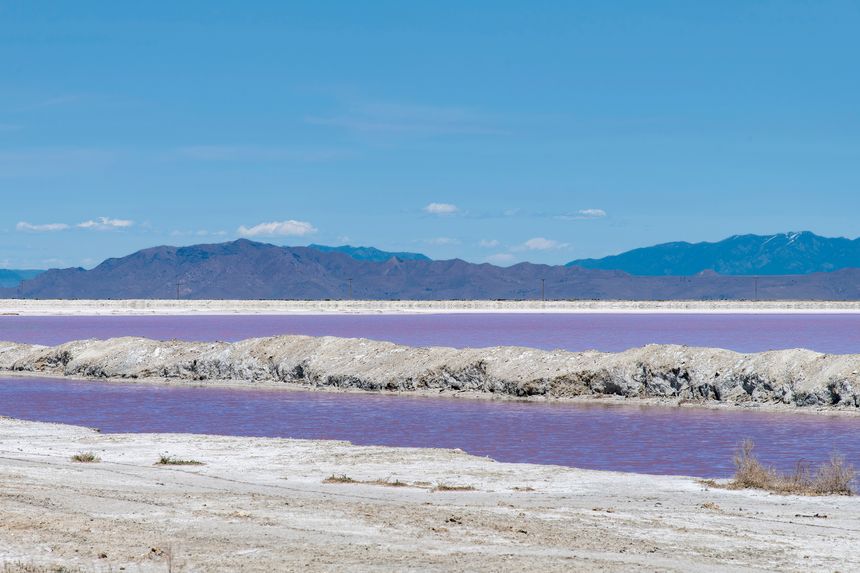
If you hadn't heard, the famous Great Salt Lake in Utah is drying up. And that's bad because the dried, exposed lake bed (over 800 square miles) contains elevated levels of metals, including arsenic. Windstorms can transport this dust, impacting air quality and public health. It also poses huge ecological problems for migratory birds and their food source.
About 80% of the lake's decline is caused by water overuse; the remaining portion can be blamed on climate change and drought. Researchers have been looking at several ways to refill the lake, but there may be some good news on the horizon.
Scientists have discovered a freshwater reservoir beneath Utah's Great Salt Lake that could span the entire area of the lake and beyond, a new study shows.
The reservoir extends up to 2.5 miles (4 kilometers) deep beneath specific spots in the lake's eastern margin, where strange, reed-covered mounds have sprouted from dried-up surfaces in recent years. If future studies can confirm that the reservoir is as large as the preliminary results suggest, its fresh water could help to restore the lake bed in places where it is cracking and creating toxic dust, the researchers said.
Fresh water from the reservoir could be used to dampen the lake bed and mitigate pollution, Farmers in the region could also potentially extract the water for irrigation, but more studies are needed.
The results imply that there may be freshwater reserves hiding elsewhere in Utah or beyond. And that could be some very good news for the drought-stricken southwestern United States.
/Passle/60211dc9e5416a0c14bc63d4/SearchServiceImages/2026-09-23-16-39-22-670-6ab400ba0e500d8e6b069e7a.jpg)
/Passle/60211dc9e5416a0c14bc63d4/SearchServiceImages/2026-09-30-10-39-14-152-6abce6d2ce06b7aee061e77e.jpg)
/Passle/60211dc9e5416a0c14bc63d4/SearchServiceImages/2026-10-05-07-46-34-555-6ac355da5a3b6bd1825bc179.jpg)
/Passle/60211dc9e5416a0c14bc63d4/SearchServiceImages/2026-10-06-16-03-57-961-6ac51beda2651f39e10fb916.jpg)