
Have you ever had someone mutter how they would move a mountain for something? And you might have thought, “yeah, right. Nobody could literally move a mountain!”
But, in this case, you would be wrong. Humans can literally move a mountain. Well, at least indirectly.
From a distance, the Matterhorn looks fixed in place, a giant wedge of rock planted above Zermatt and unchanged by time.
It is not.
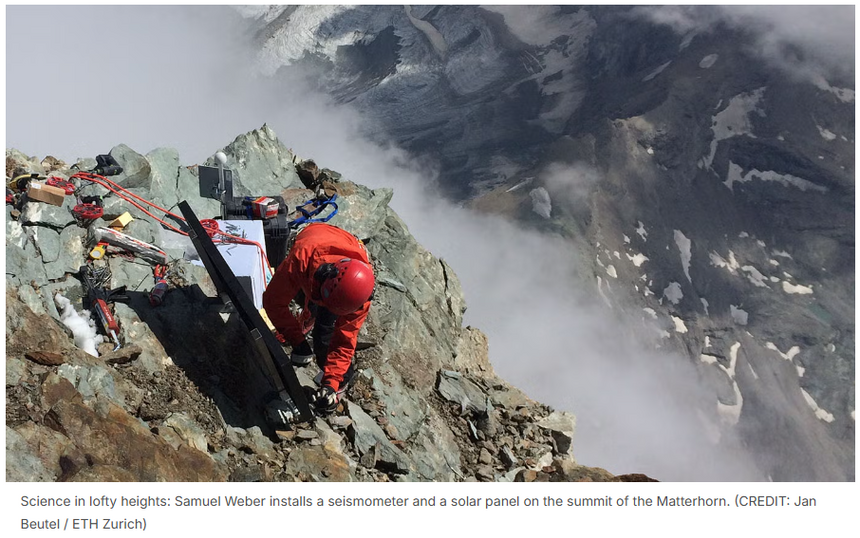
New measurements show that the famous Alpine peak is in constant motion, rocking back and forth in a slow, nearly imperceptible rhythm driven by seismic energy moving through the Earth. An international research team found that the mountain vibrates roughly once every two seconds, with motion so slight that people cannot feel it. Yet the signal is there, and on the summit it can grow much stronger than at the base.
“The movements of the underground cause every object to vibrate, which we fortunately cannot feel, but detect with sensitive measuring instruments,” Donat Fäh of the Swiss Seismological Service at ETH Zurich said in a statement.
That idea is familiar in bridges and tall buildings. The striking part here is scale. The same kind of resonant behavior can be picked up in one of the Alps’ most iconic mountains.
But don't worry. This is not a story about a mountain about to collapse.
It is a story about how even the largest landforms respond to constant background shaking from ocean-generated microseisms, earthquakes, and human activity, and how that response can become important under stronger forcing.
The results suggest that tall, steep peaks can amplify seismic motion far more than nearby valley sites. In the Matterhorn’s case, the researchers say tall mountain peaks may shake about 10 times more strongly than adjacent valleys when incoming seismic energy excites their resonant modes. That makes resonance relevant to earthquake hazard, especially for understanding where rock masses may be more vulnerable to failure.
/Passle/60211dc9e5416a0c14bc63d4/SearchServiceImages/2026-09-14-17-22-50-839-6aa82d6add088aaa425783d6.jpg)
/Passle/60211dc9e5416a0c14bc63d4/SearchServiceImages/2026-09-21-14-44-06-794-6ab142b68d381308c46013e3.jpg)
/Passle/60211dc9e5416a0c14bc63d4/SearchServiceImages/2026-09-22-20-55-53-229-6ab2eb59e77aebe36a19438f.jpg)
/Passle/60211dc9e5416a0c14bc63d4/SearchServiceImages/2026-09-27-15-40-51-115-6ab939039006ba25977a837e.jpg)