

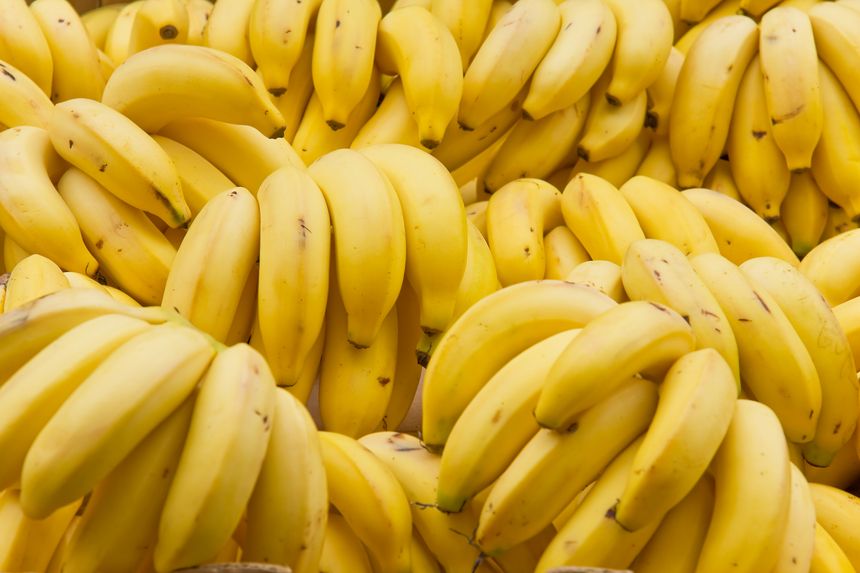
Don't worry… You won't start glowing in the dark if you enjoy a banana or two. Or even a bunch!
But while you search for the perfect ripeness at the store, you might not have thought much about also searching for the low radiation variety. But honestly, while your yellow fruit does hold some tiny amount of radiation, it's not worth losing sleep over!
It turns out that one of the key elements in bananas, and one of the main reasons people eat them, is potassium, which also makes them radioactive.
A small amount of the potassium found in bananas is the radioactive potassium-40 isotope. This radioactive potassium exists because, like everything else, the potassium element is made up of atoms. Over time, atoms decay, and in doing so, release radiation. However, only a very small amount of the atoms in potassium are radioactive — around 0.012%.
Depending on the size, a single banana contains around 0.1 microsievert of radiation. A microsievert is the unit used to measure levels of radiation absorbed that are harmful. To put that number into perspective: Experiencing one day on Earth will expose you to the same amount of radiation as found in 100 bananas, and if you travel, the airport security scan will add an additional 2.5 bananas on top. The number of bananas needed for fatal radiation levels is 100 million.
So, yes, it's still safe to enjoy this delicious fruit.
/Passle/60211dc9e5416a0c14bc63d4/SearchServiceImages/2026-09-10-08-39-43-693-6aa26ccfff5bd9fb0fee8b1c.jpg)
/Passle/60211dc9e5416a0c14bc63d4/SearchServiceImages/2026-09-08-12-37-06-384-6aa00172d27ce9f0cbadefc5.jpg)
/Passle/60211dc9e5416a0c14bc63d4/SearchServiceImages/2026-09-10-00-52-25-316-6aa1ff49ff5bd9fb0fed759a.jpg)
/Passle/60211dc9e5416a0c14bc63d4/SearchServiceImages/2026-09-09-15-01-38-177-6aa174d2313dbadbe82c2a01.jpg)




