

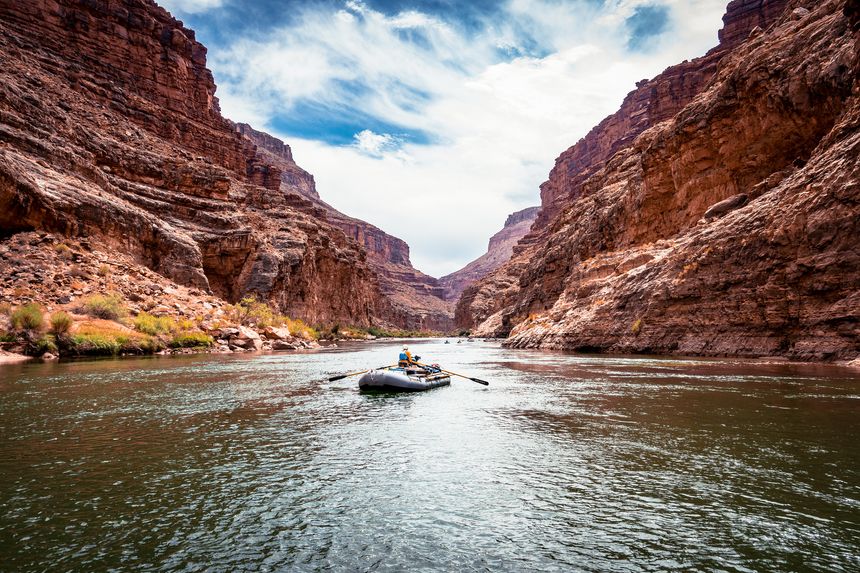
The Grand Canyon draws more scientific attention than just about any stretch of river-carved rock in the world, yet it remains steeped in mystery. After decades of debate, geologists still don’t agree on the most basic facts: How and when did it form?
A paper published today in Science marshals fresh evidence for the old—and controversial—spillover hypothesis. Around 6.6 million years ago, the authors argue, an ancestral Colorado River began draining into northern Arizona’s vast Bidahochi basin. As the basin filled with water, it formed an enormous lake that eventually spilled over its barrier into what would become the Grand Canyon. That established the river’s present-day course, along which it began to sculpt one of the most magnificent landscapes on Earth.
Ryan Crow, a geologist with the U.S. Geological Survey, says, “It’s clear that this lake had to have played a role in the formation of the canyon.” It’s not clear, however, whether that process involved catastrophic flooding or only gradual erosion.
The study doesn’t decisively rule out other contributing factors. Geologists have proposed many potential mechanisms for the canyon’s creation: maybe water dissolved a cave network until the roof collapsed, exposing an incipient gulch; maybe a small drainage eroded upstream until it captured the Colorado River, sucking the mighty waterway into its own channel. But Crow argues that, given the available evidence, “spillover of this large lake is perhaps an easier and much simpler and more likely mechanism.”
/Passle/60211dc9e5416a0c14bc63d4/SearchServiceImages/2026-10-16-11-16-08-226-6ad20778f0722e0f6fffd010.jpg)
/Passle/60211dc9e5416a0c14bc63d4/SearchServiceImages/2026-10-22-14-57-06-228-6ada2442594ea8e6e3b00785.jpg)
/Passle/60211dc9e5416a0c14bc63d4/SearchServiceImages/2026-10-15-08-01-34-892-6ad0885ed13e4bbdf6a6a870.jpg)
/Passle/60211dc9e5416a0c14bc63d4/SearchServiceImages/2026-10-06-17-19-56-342-6ac52dbc4e3377a132b46e72.jpg)