

It's 2025, so why are we still pumping air in our tires for crying out loud? (and why don't we have briefcase flying cars like George Jetson? But I digress…)
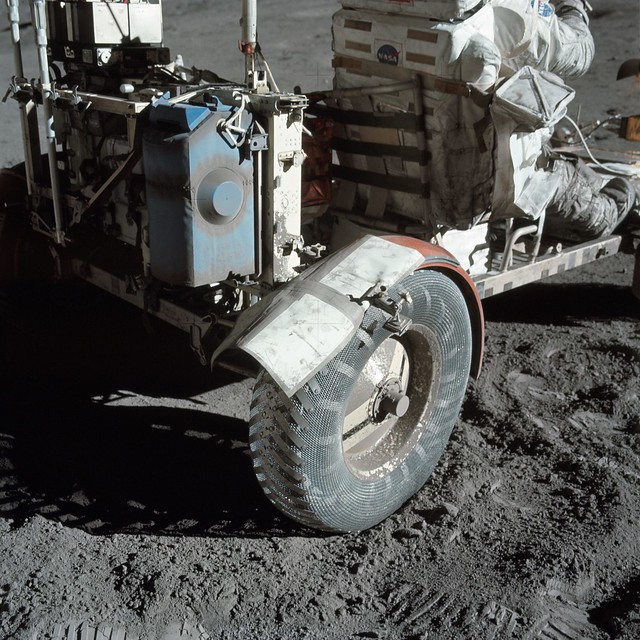
Tire manufacturers have had airless tires for quite some time now. They're flat-proof, supposedly maintenance-free, and have been in development since flip phones were still a thing. On paper, it sounds like the kind of sensible upgrade cars should've had a decade ago. And yet, here we are, still stuck with old-fashioned air-filled black rubber doughnuts. Heck, even the Apollo lunar rover back in the '70s had airless tires, and that was 50 years ago!
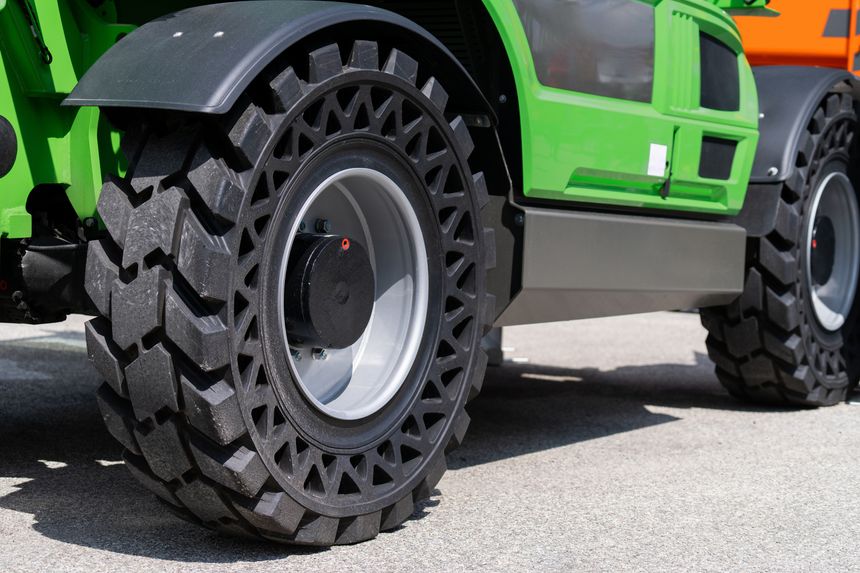
The idea behind airless — or non-pneumatic — tires isn't exactly new. Michelin introduced the Tweel in 2005. More recently, its UPTIS (Unique Puncture-proof Tire System) prototype promised a legit airless design for passenger cars. Goodyear, Bridgestone, and others have thrown their own versions into the mix. The appeal is clear: no punctures, no blowouts, and far less worry about pressure checks or uneven wear. According to Michelin's internal testing, their UPTIS system could eliminate nearly 200 million scrap tires a year caused by flats and underinflation. So what's the holdup?
One reason is simple physics. Traditional tires rely on air pressure to distribute load evenly and absorb road shocks. Remove that cushion, and suddenly everything from ride comfort to handling takes a hit due to airless tires' stiffness. Current airless prototypes tend to transfer more road noise and vibration into the cabin than traditional radials — making the ride harsher, especially at highway speeds.
Heat buildup is another issue. At high speeds, traditional tires dissipate heat through their air volume and structure. Airless designs — particularly those with internal webbing or solid cores — have fewer ways to shed thermal load, which can lead to material fatigue or performance degradation. Bridgestone's concept tires for lunar rovers have demonstrated durability, but that's a far cry from your daily commute on hot asphalt.
Weight is also a factor. Without internal air, the structure of an airless tire has to do more heavy lifting, literally. Hence, the need for sturdier but weighty materials comes in. The added materials' mass can affect fuel economy and increase unsprung weight — bad news for handling and suspension tuning. That's part of why Michelin's UPTIS design is being beta-tested first on compact EVs, where packaging and torque delivery are more forgiving. Some early tests even showed increased rolling resistance compared to standard tires, which could hurt efficiency over time. Pneumatic tires may be the best tires now for EVs, but airless is catching up.
Then there's regulation. Vehicle tires are subject to rigorous performance standards, many of which assume air pressure as a baseline. Airless tires would require new categories, new safety certifications, and new federal test procedures. Until regulators catch up, manufacturers can't legally put these things on just any car. According to the National Highway Traffic Safety Administration, even minor tire modifications must pass extensive load, endurance, and deformation testing before they're allowed on public roads — rules airless models must essentially rewrite.
One day flat tires may just be a distant memory, but for now… watch those potholes!
/Passle/60211dc9e5416a0c14bc63d4/SearchServiceImages/2026-09-08-15-59-47-905-6aa030f3d27ce9f0cbae7a79.jpg)
/Passle/60211dc9e5416a0c14bc63d4/SearchServiceImages/2026-09-09-15-01-38-177-6aa174d2313dbadbe82c2a01.jpg)
/Passle/60211dc9e5416a0c14bc63d4/SearchServiceImages/2026-09-04-10-40-38-568-6a9aa0260d5bc279697263a2.jpg)
/Passle/60211dc9e5416a0c14bc63d4/SearchServiceImages/2026-09-03-15-41-56-326-6a9995447466c353608b5180.jpg)




