

Exploding trees is funny to say, and to visualize in your mind. And it would be a great band name!
And, thanks to the bitter cold due to the polar vortex this year, “exploding trees” will be in the running for word of the year. But is it a real thing?
Well, yes. And no.
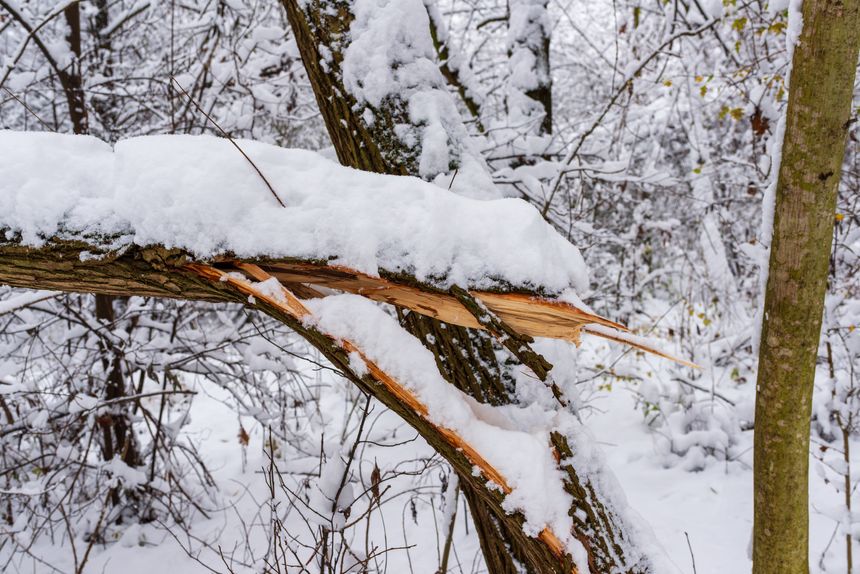
As cold air settles in, moisture and sap inside a tree can freeze and expand faster than the wood can adjust. The result can be a dramatic split in the trunk or bark, a phenomenon commonly referred to as frost cracking. Though trees don’t truly “explode” in the way the word suggests, the sound and suddenness of these cracks can be startling.
What Is Frost Cracking?
When the temperature outside drops rapidly or extremely, sometimes a phenomenon called frost cracking can occur. It happens when the sap inside a tree freezes (and therefore expands) faster than the wood around it. This causes internal pressure to build up to the point where the surrounding wood can’t contain it anymore and cracks suddenly. This release of pressure often produces a loud cracking or popping sound that can be mistaken for an explosion.
Typically, these cracks form as long, vertical splits along the trunk. Most often, these splits will be on the side of the tree that gets the most sun, where daytime warming is followed by an abrupt nighttime freeze. Frost cracking is most common during severe cold snaps, especially when temperatures fall quickly after a mild or thawed period. The sudden change gives the tree little time to adjust, increasing stress on the wood fibers.
Certain tree species are more prone to frost cracking than others. These include maple, oak, sycamore, and many fruit trees. Older trees or those already weakened by disease, drought, or previous damage are also at higher risk. While some trees can heal over time, repeated frost cracking can leave them structurally compromised, making them more vulnerable to insects, decay, and future weather extremes.
Trees Can “Explode” in Extreme Heat, Too
“Exploding” trees don’t just happen in the dead of winter; they can happen in the heat as well. But not usually to the same extent. Prolonged high temperatures and intense sunlight place significant stress on a tree, particularly when moisture levels inside the tree fluctuate rapidly. In these conditions, water within the trunk can heat up and expand, creating pressure beneath the bark.
/Passle/60211dc9e5416a0c14bc63d4/SearchServiceImages/2026-09-21-14-44-06-794-6ab142b68d381308c46013e3.jpg)
/Passle/60211dc9e5416a0c14bc63d4/SearchServiceImages/2026-09-22-20-55-53-229-6ab2eb59e77aebe36a19438f.jpg)
/Passle/60211dc9e5416a0c14bc63d4/SearchServiceImages/2026-09-27-15-40-51-115-6ab939039006ba25977a837e.jpg)
/Passle/60211dc9e5416a0c14bc63d4/SearchServiceImages/2026-09-24-10-34-45-556-6ab4fcc5ce1e0391003c4632.jpg)