

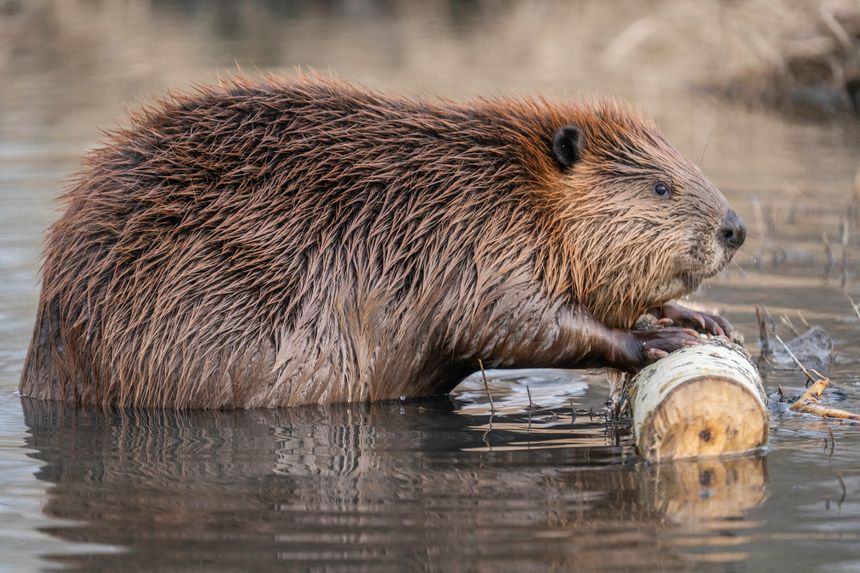
The beaver is nature's engineer. By creating their dams, beavers are capable of transforming once-dry landscapes into lush, green wetlands that support many other land- and water-dwelling species. Now, two new studies suggest these benefits also extend to creatures who spend much of their time in the air.
The first, published in the Journal of Animal Ecology, finds that beaver-engineered ecosystems are a boon to bats, which seem to be drawn to these habitats by the abundance of roosting sites and tasty insects. The second, published in the Journal of Applied Ecology , explains how beaver-created wetlands lure pollinators like hoverflies and butterflies.
Both bats and pollinator insects face significant threats to their survival, including habitat loss, climate change, pesticides, pollution and disease. Together, the new findings suggest efforts to support and protect beavers might, in turn, help these vulnerable species, too.
Scientists suspect that bats are drawn to the beaver ponds for several reasons. A big one is that the beaver-engineered ecosystems have more standing deadwood—dead trees that remain upright—which some bat species like to use for roosting. Standing deadwood also attracts bugs like beetles, gnats, flies and moths, which means beaver ponds are fertile foraging grounds for bats.
But why the butterflies? Researchers suspect that the hoverfly and butterfly populations can be explained by the types of plants growing at the sites. Because they are more dynamic, beaver ponds tend to have a lot of fast-growing plants that reproduce quickly and produce a lot of flowers, making the locations ideal for pollinators.
/Passle/60211dc9e5416a0c14bc63d4/SearchServiceImages/2026-09-21-14-44-06-794-6ab142b68d381308c46013e3.jpg)
/Passle/60211dc9e5416a0c14bc63d4/SearchServiceImages/2026-09-22-20-55-53-229-6ab2eb59e77aebe36a19438f.jpg)
/Passle/60211dc9e5416a0c14bc63d4/SearchServiceImages/2026-09-27-15-40-51-115-6ab939039006ba25977a837e.jpg)
/Passle/60211dc9e5416a0c14bc63d4/SearchServiceImages/2026-09-24-10-34-45-556-6ab4fcc5ce1e0391003c4632.jpg)