

Sunflowers are one of my favorites. They remind me of summer, warm weather, and the shape and bright yellow color just makes me happy.
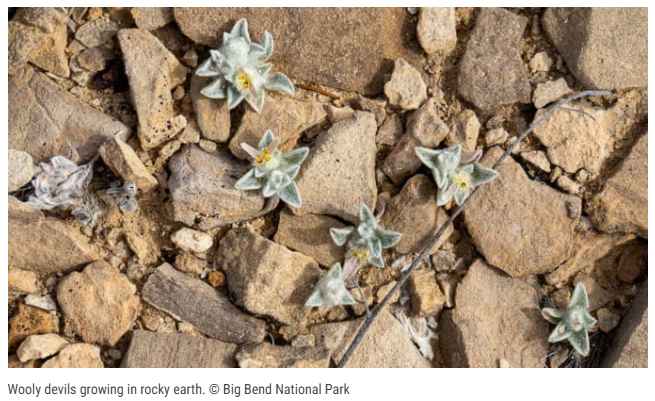
But a new sunflower species was recently discovered in the Big Bend National Park in Texas, and it looks nothing like what we think a sunflower should look like! In fact, to me it looks more like something you would see on an alien planet in a sci-fi movie.
The flower, called Ovicula biradiata and dubbed the “wooly devil,” is described in a study published February in the journal PhytoKeys. The Big Bend National Park is well known to botanists, underscoring the fact that even extensively studied regions can still yield surprises, and it was the first time a new plant genus and species has been identified in a U.S. national park in almost five decades.
Botanist Isaac Lichter Marck said O. biradiata belongs to the sunflower family, even though it doesn’t immediately resemble its typically radiant, sunburst-like kin. As for the plan's name it was derived from “Ovicula” which means “tiny sheep,” referencing the plant’s furry leaves and the Big Bend’s bighorn sheep, while “biradiata,” meaning “bi-radial,” highlights its maroon stripes.
“After sequencing its DNA and comparing it with other specimens in the Academy’s herbarium, we discovered that this small, fuzzy plant is not only a new species within the sunflower group, but it is also distinct enough from its closest relatives to warrant an entirely new genus,” he added. A genus is the biological classification between species and family.
A park volunteer first observed the wooly devil in March 2024 and uploaded its information into a community science app called iNaturalist. This small plant features furry white leaves and maroon-striped ray florets (petal-looking parts of a flower head). Botanists call it a “belly plant” because it’s easiest to observe when lying down. It thrives in rocky, dry habitats and blooms only after it rains.
“Now that the species has been identified and named, there is a tremendous amount we have yet to learn about it,” said Carolyn Whiting, a Big Bend National Park botanist and co-author of the study. She’s hoping to find other populations of the wooly devil elsewhere in the park, and to also learn more about its life cycle and reproductive processes. As a drought is currently hitting the region, it’s unknown if new plants will appear later this spring, Whiting said.
Back in the lab, the researchers documented the presence of glands on the wooly devil that have been found to possess anti-cancer and anti-inflammatory compounds in other members of the sunflower family. While these properties still need to be confirmed in the new species, California Academy of Sciences’ Keily Peralta, another co-author of the study, said “this discovery underscores the potential knowledge we stand to gain from preserving plant diversity in fragile desert ecosystems.”

/Passle/60211dc9e5416a0c14bc63d4/SearchServiceImages/2026-10-16-11-16-08-226-6ad20778f0722e0f6fffd010.jpg)
/Passle/60211dc9e5416a0c14bc63d4/SearchServiceImages/2026-10-22-14-57-06-228-6ada2442594ea8e6e3b00785.jpg)
/Passle/60211dc9e5416a0c14bc63d4/SearchServiceImages/2026-10-15-08-01-34-892-6ad0885ed13e4bbdf6a6a870.jpg)
/Passle/60211dc9e5416a0c14bc63d4/SearchServiceImages/2026-10-06-17-19-56-342-6ac52dbc4e3377a132b46e72.jpg)




