

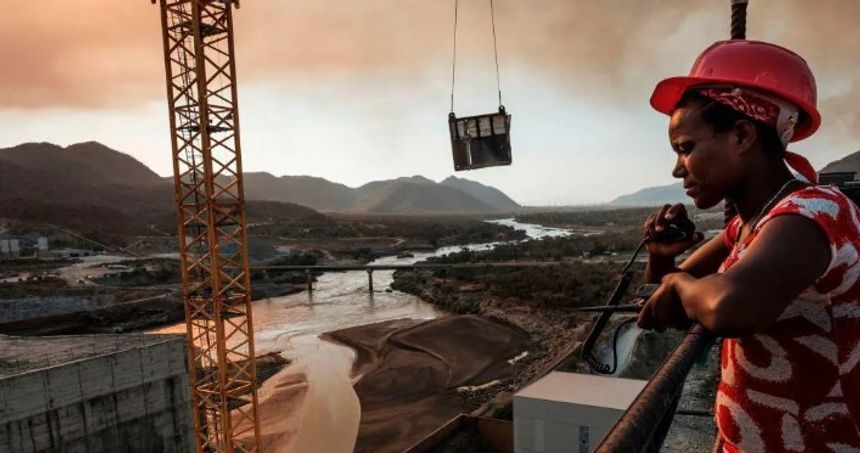
When a young Ethiopian mechanical engineer first set foot on the massive construction site, the scale of the task ahead was almost unimaginable.
Hundreds of workers were already toiling in difficult conditions, digging deep into the rocky ground to lay the foundations of what would become Africa’s largest hydroelectric dam. Rising across the Blue Nile, the project promised not only to light up Ethiopia but also to supply energy across the region.
For Moges Yeshiwas, then a 27-year-old eager to sharpen his skills, arriving at the remote site in western Ethiopia in 2012 marked the beginning of a life-changing journey. While the project aimed to transform his nation’s future, it also profoundly shaped his own career.
This week, Prime Minister Abiy Ahmed officially inaugurated the Grand Ethiopian Renaissance Dam (GERD), calling it “the greatest achievement in the history of the Black race.” Flanked by Kenya’s President William Ruto and Djibouti’s President Ismail Guelleh, Abiy unveiled a commemorative plaque and oversaw the powering up of the turbines.
The GERD is a feat of engineering: a 1.78km (1.1-mile) wall of concrete rising 145m (475ft) high, built with 11 million cubic metres of concrete. Behind it lies a vast reservoir named Lake Nigat—“dawn” in Amharic—symbolizing a new era for Ethiopia.
Yet the dam’s construction has not been without controversy. Built on a major tributary of the Nile, which provides the bulk of the river’s flow, the project sparked diplomatic tensions with downstream countries, particularly Egypt. Fears over water access led to heated negotiations and even talk of potential conflict.
Despite the disputes, the GERD has come to embody Ethiopia’s determination and national pride. For Abiy and many Ethiopians, the dam is more than a source of power—it is a statement that the country has claimed its place on the global stage.
/Passle/60211dc9e5416a0c14bc63d4/SearchServiceImages/2026-10-07-03-07-28-884-6ac5b770e2138e97236d8711.jpg)
/Passle/60211dc9e5416a0c14bc63d4/SearchServiceImages/2026-10-03-02-21-11-638-6ac066977c1a0b1c3a065bb9.jpg)
/Passle/60211dc9e5416a0c14bc63d4/SearchServiceImages/2026-09-27-17-44-10-859-6ab955eaef3ecc8443aa618d.jpg)
/Passle/60211dc9e5416a0c14bc63d4/SearchServiceImages/2026-10-14-08-11-38-961-6acf393a477453bcaa310c72.jpg)