

Sure, you may think you know what the Eiffel Tower looks like. Or the pyramids. And of course the Statue of Liberty. But I bet you never knew that how they look today is, in some cases, vastly different that when they were first constructed!
Let's take a look at the Eiffel Tower first. Did you know that the Eiffel Tower has donned eight different shades of color since it was first constructed? In 1888, the iconic structure was painted a vivid hue called Venetian red, which was applied at the workshop of its namesake designer, Gustave Eiffel. The next year, however, it was painted a different reddish-brown color for the 1889 world’s fair. In 1892, the tower received a coat of ochre-brown, and in 1899, just before the 1900 world’s fair, Gustave Eiffel decided it should be yellow — five gradient shades to be exact, ranging from light yellow at the top to orange-yellow at the base.
The Statue of Liberty is arguably America’s most treasured landmark, but it didn’t always have its famous green patina. Designed by French sculptor Frédéric-Auguste Bartholdi, Lady Liberty was gifted to the United States to commemorate a friendship with France and the two nations’ shared ideals of liberty.
When she was unveiled in 1886, the copper-clad statue was simply the color of copper — a glimmering reddish-brown, similar to the color of a penny. When the statue was placed on Liberty Island in New York Harbor, the copper coating began to oxidize as it was exposed to the elements, resulting in the blue-green hue we recognize today.
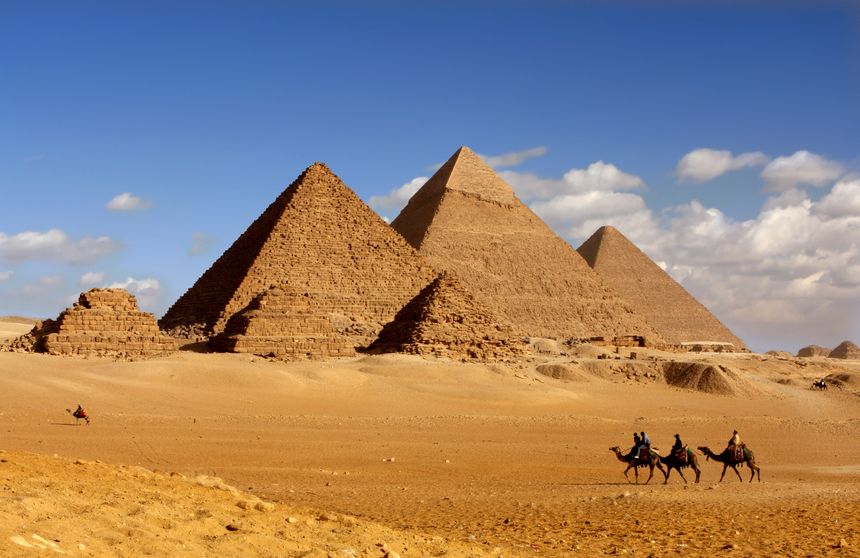
And would you believe that the famous pyramids of Egypt used to be… get this… white! Today, the pyramids are so old and weathered that they have the same sandy appearance of the surrounding desert. But they were originally encased in smooth, polished white limestone blocks, which have faded over time. Historians also speculate that the Great Pyramid once had a pyramidion or capstone made of gold or covered in gold or electrum (a gold and silver alloy).
Next up, we travel to Italy. The Colosseum of Rome, another weathered ancient ruin, also once had a more opulent appearance. Though the landmark was originally encased in glistening white travertine marble, it was removed over time and used for other construction projects, such as St. Peter’s Basilica in Vatican City.
The marble was attached to the underlying structure with iron clamps and pins, which were also removed — leaving the holes that we see today.
And our last stop if the Hollywood sign in the hills. The one made famous by the movies, but started life as an advertisement for a building company!
Although it’s now one of California’s most famous landmarks, the Hollywood Sign wasn’t intended to be a permanent fixture in the Hollywood Hills. In 1923, a company called Hollywoodland Property started selling homes and plots of land in the Santa Monica Mountains and created the sign, which originally read “Hollywoodland” as an advertisement. The original sign was 800 feet long and 50 feet tall and featured 4,000 light bulbs to illuminate the letters at night.
The sign was only supposed to remain standing for a year and a half, but it towered over the hills until 1949, when residents complained of its disrepair and demanded it be removed. Instead, the Hollywood Chamber of Commerce repaired and modified the sign, dropping the “land” in Hollywoodland.
/Passle/60211dc9e5416a0c14bc63d4/MediaLibrary/Images/2024-07-25-19-34-58-437-66a2a8e2012a075bf2d3886e.jpg)
/Passle/60211dc9e5416a0c14bc63d4/SearchServiceImages/2026-08-28-21-08-00-332-6a91f8b0de355275bbc2047e.jpg)
/Passle/60211dc9e5416a0c14bc63d4/SearchServiceImages/2026-09-01-19-40-59-331-6a972a4bf9386af8ea707113.jpg)
/Passle/60211dc9e5416a0c14bc63d4/SearchServiceImages/2026-09-03-11-57-48-238-6a9960bc7466c353608a92a5.jpg)